

A Christian Festival That Isn’t from the Bible
Every year at Christmas, Christians around the world celebrate the birth of “Jesus” on December 25. Gifts are exchanged, trees are decorated, lights go up, carols are sung — but this celebration is not rooted in Scripture.
The Bible does not:
Give a date for the Messiah’s birth
Command believers to celebrate His birth
Provide instructions for any feast tied to His birth
Instead, the Christmas date of December 25 comes from a long tradition that predates Christianity by centuries. The early church — centuries after YAHUSHUA walked the earth — adopted this date as a convenient way to overlay pagan winter festivals with Christian theology. This was a strategic syncretism — merging idol worship with emerging “Christian” practice.
But Scripture warns believers:
“Take heed that no man deceive you.”
— Matthew 24:4 (KJV)
Deception doesn’t always come with horns and a pitchfork. Sometimes it comes with carols and candy canes.
When a holiday claims to honor YAHUAH and YAHUSHUA but is rooted in practices designed to honor pagan gods, we must ask: Who is truly being worshiped?
December 25 Was Not Chosen in the Bible — It Was Stolen from Pagans
There is no biblical record specifying a date for the birth of the Messiah. The Gospels describe shepherds in the fields (Luke 2), which more likely points to a spring or fall birth — not midwinter in the cold of December.
Historical evidence shows that December 25 was already celebrated as a feast a century before Christianity:
Saturnalia
An ancient Roman festival honoring Saturn, the god of agriculture.
Celebrated mid‑December with revelry, feasting, gift‑giving, and public merriment.
It was a period of overturning norms: slaves and masters switched roles, excess was encouraged, and social order was temporarily loosened.
This feast had no connection to Scripture — it was a completely pagan celebration that honored false gods and human indulgence.
Dies Natalis Solis Invicti
Also called the Birthday of the Unconquered Sun, this feast was held on December 25 by the Romans to celebrate the rebirth of the sun after the winter solstice. Sol Invictus was a sun deity whose festival involved worship, feasting, and rituals extolling the power of the sun.
When early Christian leaders adopted December 25, they effectively replaced a sun festival with a so‑called Christian festival — without a scriptural mandate. This choice did not emerge out of divine revelation but out of cultural compromise. Rather than tell pagans to cease their celebrations entirely, the church repurposed them.
This historical fact is well documented by historians and institutions that track ancient religious practices and holidays.
The critical point is this:
December 25 was not divinely appointed by YAHUAH — it was borrowed and repackaged.
Yet the church treats it as sacred.
The Bible teaches the path of truth, not tradition:
“In vain do they worship me, teaching for doctrines the commandments of men.” — Matthew 15:9 (KJV)
The Customs of Christmas Were Borrowed from Pagan Rituals
If we look closely at today’s Christmas practices, we see striking parallels to pre‑Christian pagan festivals.
Christmas Trees and Evergreen Traditions
Long before Christianity, ancient cultures used evergreens in midwinter as symbols of life persisting through death and darkness. Trees, wreaths, and greenery were placed in homes during Saturnalia and Germanic Yule celebrations. Also, it has origins that predate that, going back to Babylon and Saturn worship.
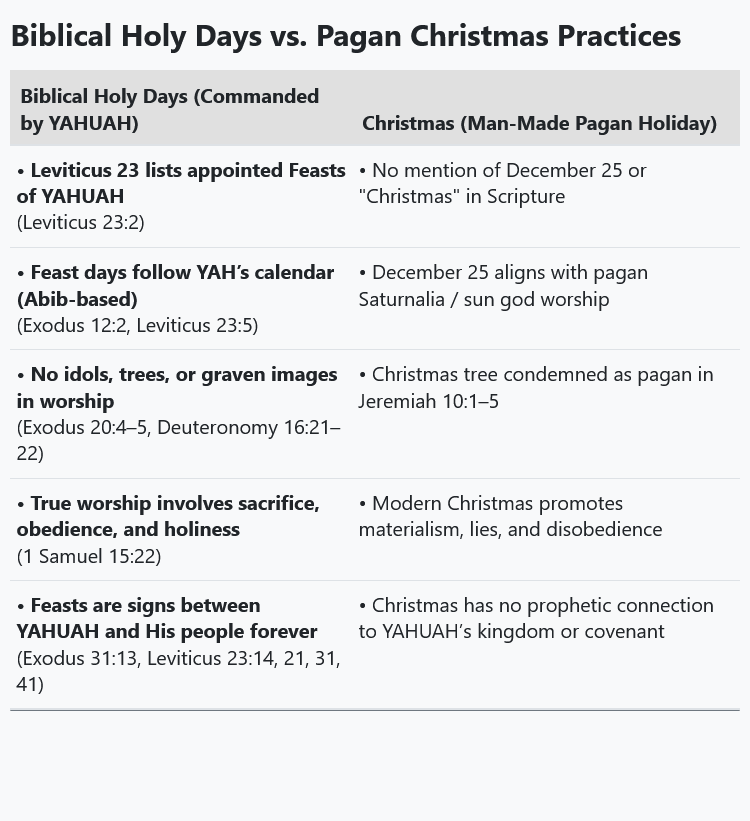
This symbolic adoption was entirely absent from Scripture, and it reflects pagan beliefs about nature spirits and seasonal cycles — not the Torah’s emphasis on set‑apart objects or appointed times.
Gift‑Giving
Gift exchange during Saturnalia was customary — not rooted in the life of the Messiah. Romans would give each other tokens and presents, mirroring the winter feast’s spirit of revelry and social inversion. When Christianity absorbed these ideologies, it simply repackaged them with biblical language.
Feasting and Merriment
While feasting is not inherently wrong, the context matters. Christmas feasting is tied to a date and rituals that Scripture does not sanction. The biblical feasts in Leviticus 23 are commanded by YAHUAH, and each has specific spiritual purposes — nothing like the late‑December feasts tied to winter traditions.
Santa Claus, Old Saint Nick, and the Yuletide Gift Bearer
The modern figure of Santa Claus merges several streams of tradition:
Saint Nicholas of Myra, a 4th‑century bishop whose life became legendary.
European pagan folklore figures associated with winter gift‑giving.
A composite character formed through centuries of cultural blending.
It is crucial to understand that this figure is not biblical. There is no scriptural support for a supernatural gift‑bearer who comes down chimneys, rides reindeer, or rewards children with treats for good behavior. This character is primarily built from folklore and myth, not Scripture.
While historians do not claim that “Old Saint Nick” is literally Satan himself in many scholarly sources, the function of this figure is undeniably rooted in folklore that predates and exists outside biblical truth. When folklore becomes merged with Christian celebration, the result is a religious hybrid.
The caller of light — the solar festivals, customs, and winter rites — has long been intertwined with spiritual systems opposed to Scripture.
The Apostle Paul warned of the dangers of syncretism:
“Beware lest any man spoil you through philosophy and vain deceit, after the tradition of men…” — Colossians 2:8 (KJV)
Christmas Is Rooted in Sun Worship — Not Messiah Worship
Let us make this connection very explicit:
The Roman feast of Dies Natalis Solis Invicti — the “birth of the unconquered sun” — was celebrated on December 25. The sun god’s “rebirth” coincided with the winter solstice — the moment when days begin to lengthen again. This was a nature‑based religion, centered on celestial bodies and the worship of created things.
But Scripture clearly distinguishes the Creator from His creation:
“The sun and the moon… these are set in place by YAHUAH… not to be worshiped.” — Psalm 19:1–4 (KJV) in context
Hanukkah, Passover, Trumpets, Atonement, Tabernacles — these come from YAHUAH Himself.
Christmas, as practiced historically, emerged from pagan sun and solar worship — not from divine revelation.
Consider the words of the Apostle John:
“Little children, keep yourselves from idols.” — 1 John 5:21 (KJV)
Christmas — as a celebration on December 25 with symbols of sun/light worship — falls uncomfortably close to the very thing the Bible warns us to flee.
The Bible Never Commands Celebrating Christmas
Let us allow the Word of YAH to settle this issue:
The Bible explicitly commands YAH’s people to observe certain festivals:
✔ Passover — Exodus 12
✔ Unleavened Bread — Exodus 12
✔ Feast of Firstfruits — Leviticus 23
✔ Pentecost — Leviticus 23
✔ Feast of Trumpets — Leviticus 23
✔ Day of Atonement — Leviticus 23
✔ Feast of Tabernacles — Leviticus 23
Not once — not even in the Gospels — does the Bible command believers to observe the date of the Messiah’s birth. Not even the early prophetic community kept a “birthday of YAHUSHUA.”
This presents an unambiguous point:
If YAH wanted His people to observe His Son’s birth, He would have commanded it.
Instead, what we see historically is a late adaptation of pagan symbolism into Christian devotion — all in the name of “celebrating Jesus.”
Christmas is not a divine feast — it is a cultural festival repackaged as religion.
The Bible calls us not to adopt the festivals of the nations:
“Thus saith YAHUAH… Learn not the way of the nations, and be not dismayed at the signs of heaven… for the customs of the people are vain.” — Jeremiah 10:2–3 (KJV)
Christmas Is a Tool of Babylonian Influence — A Spiritual Trap
Christmas has become one of the most pervasive cultural observances on Earth. Its messages are projected through:
Music
Retail advertising
Television
Movies
Political messaging
Society treats Christmas as a secular holiday — but the spiritual underpinnings are anything but secular.
Christmas is statistically and culturally tied to:
Consumerism
Materialism
Secular morality shifts
Social pressure to participate despite conscience
This fits the description of Babylon — a system that seduces the whole world into compliance:
“Babylon is fallen, is fallen…” — Revelation 18:2 (KJV)
Christmas has become a marker of conformity more than a celebration of Christ.
The prophet Isaiah warned:
“Woe unto them that call evil good, and good evil.” — Isaiah 5:20 (KJV)
When a festival built on sun worship, pagan rites, and idol traditions is reframed as devotion to YAHUSHUA, it means we have labeled evil as good — replacing truth with a counterfeit.
Why Hebrew Israelites Must Reject Christmas
Hebrew Israelites are called to walk a separate path — to reject the ways of Babylon, Egypt, and Assyria, and to return to the statutes and commandments given by YAH through Moses:
“Come out of her, my people…” — Revelation 18:4 (KJV)
Christmas represents:
✘ A pagan origin
✘ A non‑biblical observance
✘ A blend of sun/saturn worship with Christian rhetoric
✘ A departure from Torah‑ordained appointed times
Romans 12:2 warns:
“Be not conformed to this world…” — Romans 12:2 (KJV)
Celebrating Christmas is a form of conformity to Babylonian culture and religious human tradition disguised as Christianity.
YAH calls us to obedience — not convenience.
Worship YAH in Truth and Spirit
Christmas is widely accepted, deeply sentimental, and culturally powerful — yet it is built on traditions that predate Scripture, span pagan religions, and obscure the biblical path of worship.
The Apostle Paul’s warning to the Colossians rings true today:
“Beware lest any man spoil you through philosophy and vain deceit, after the tradition of men…” — Colossians 2:8 (KJV)
If you want to honor YAHUAH and YAHUSHUA, do so in the way He commanded — through obedience to Torah and faith in His promises — not through the rituals of Babylonian feasts repackaged with Christian labels.
Reject the lies.
Cherish the truth.
Walk in obedience.
In review
Keep in Touch
Explore the full Unknown Hebrew Collection for more scripture-based studies.
Stay updated with teachings — follow Unknown Hebrew on Substack.
Have questions? Contact Unknown Hebrew directly.
Shalom,