


The Debate Over the Name
Among Hebrew Israelites, no topic stirs more debate than the Sacred Name. Some say the Father’s name is YAHUAH, others AHAYAH, others YAHWEH, and others YAHAWAH. Some simply say YAH, based on Psalm 68:4. Still others say the name has been lost, corrupted, or intentionally hidden.
This debate exists because:
Hebrew was written without vowels, leaving pronunciation open.
Israel spent centuries in captivity, losing original language fluency.
The name was considered too holy to pronounce by rabbinic Jews.
The Scriptures contain multiple name forms, even within the same narratives.
But while honoring His name is important, the Most High never intended for believers to be divided over vowel sounds. And most shocking of all:
The Scriptures clearly teach that He will reveal a NEW name when He returns—meaning none of us currently speak the final form.
This article explores the origins and differences of each name, then proves through Scripture that the Name will indeed change in the Kingdom.
The Tetragrammaton: YHWH and Its Variations
The most common foundational name is the Tetragrammaton—the four Hebrew letters:
יהוה — YHWH
This form appears over 6,800 times in the Hebrew Scriptures. It is the personal covenant name given to Israel.
Where the variations come from
Since ancient Hebrew had no vowel markings, the original pronunciation is debated. This leads to reconstructions such as:
YAHUAH
YAHWEH
YAHUWAH
YEHOVAH (in modern Jewish tradition)
These reconstructions add vowels to the consonants Y‑H‑W‑H.
Why so many?
Scholars disagree about how ancient Hebrew vowels were pronounced.
The Masoretes (medieval Jewish scribes) added vowel points centuries after the exile—often intentionally “disguising” the Name.
Some Israelites prefer Paleo‑Hebrew pronunciation, while others use Masoretic Hebrew or phonetic reconstructions.
Scriptural Use
YHWH is used in covenant language:
Exodus 3:15 – “This is my name forever…”
Exodus 6:3 – “I appeared unto Abraham… but by my name YHWH was I not known to them.”
This establishes YHWH as a covenant identifier, not necessarily a phonetic requirement.
AHAYAH: The Name Revealed to Moses?
Those who use AHAYAH base their belief on Exodus 3:14:
“Ehyeh Asher Ehyeh” — “I AM THAT I AM.”
This was spoken when Moses asked for the Father’s name. Some conclude this means His name is AHAYAH (“I AM”).
The Linguistic Issue
“Ehyeh” (אהיה) is first‑person (“I am”).
But names are spoken in third‑person, not first-person.
Meaning: The Father said “I AM”, but Israel calls Him “HE IS.”
That is why the next verse switches to:
“YHWH (He is/He exists) … this is my memorial unto all generations.” — Exodus 3:15
So “AHAYAH” is a statement, while “YHWH” is the name Israel calls Him.
Still, many use AHAYAH to emphasize the self‑existence and eternal nature of the Father.
YAHAWAH: A Paleo-Hebrew Reconstruction
Many Israelites from One West Hebrew Israelite traditions use the name:
YAHAWAH (or YAH‑HA‑WAH)
This comes from Paleo‑Hebrew phonetic logic:
Ya = Yod
Ha = Heh
Wa = Waw
Ha = Heh
This approach argues Hebrew should be read with the simplest ancient vowel sounds.
Why they use it
They believe Paleo Hebrew restores the original pronunciation.
They want to avoid modern “Jewish” vowel traditions.
They connect the “Yah‑Ha‑Wah” form with older Canaanite inscriptions and phonetic patterns.
Though not universally accepted, it is widely used among different Hebrew Israelite groups.
YAH and Other Shortened Forms
“YAH” is one of the most undeniable and biblically supported names.
Psalm 68:4
“Sing unto ELOHIM… extol Him by His name YAH…”
HalleluYAH
The most common word in Scripture using His name is:
Hallelu‑Yah = “Praise Yah”
This suggests ancient Israel clearly used “Yah” vocally even if the full pronunciation is debated.
Shortened forms include:
Yah
Yahu
Yahh
Names like Eli‑Yahu (“My God is YAH”)
These are praise forms but also hint at the full name containing “YAH.”
Differences Between These Names
Here are the major differences summarized:
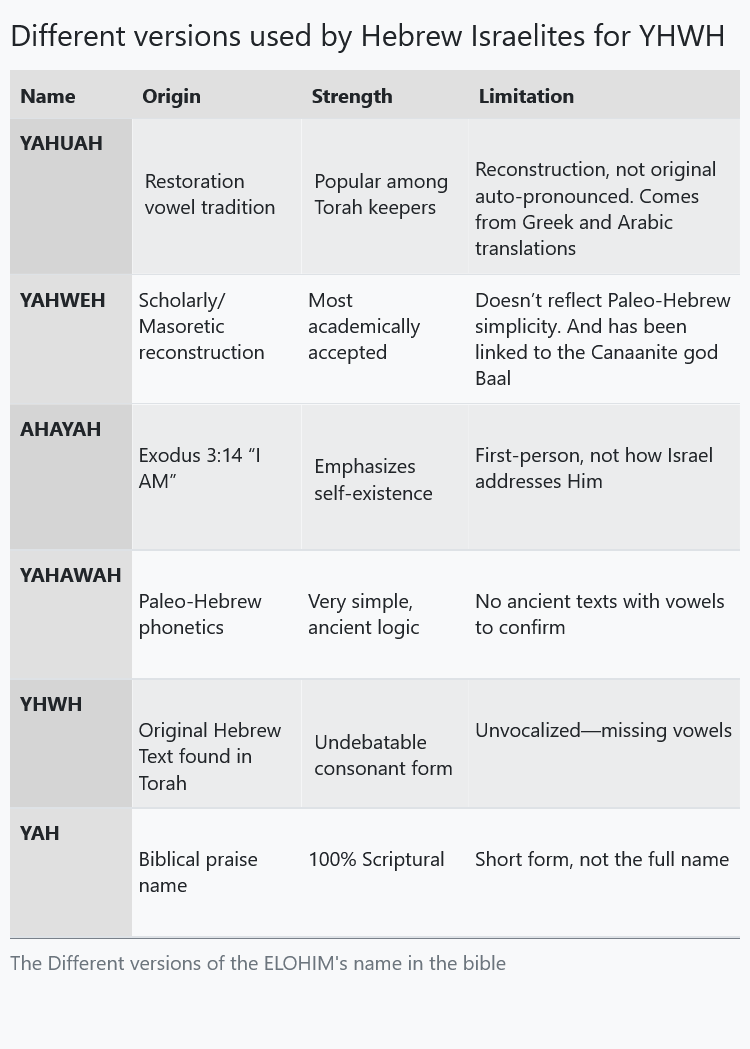
Conclusion:
All these names aim to honor the Most High—but none can be considered the final revealed name.
Why?
Because Scripture says His name will change.
Scriptural Proof That His Name Will Be Changed
This is the section most people overlook.
The Bible explicitly teaches that when the Most High returns, He will reveal:
A new name
A pure language
A new identity marker upon His people
This means the name we use today—whatever form—is temporary.
Revelation 3:12 — YAHUSHUA speaking
“I will write upon him my NEW NAME.”
Not His “old name.”
Not His “restored name.”
Not His “ancient name.”
NEW.
This alone settles the debate.
Isaiah 62:2
“And thou shalt be called by a new name, which the mouth of YHWH shall name.”
This prophecy refers to Israel and the Holy One’s identity in the renewed kingdom.
Zephaniah 3:9
“For then will I turn to the people a pure language, that they may all call upon the name of YHWH, to serve Him with one consent.”
This means:
The current languages (including modern Hebrew) are not pure.
Pronunciation issues will be resolved.
A unified, heavenly pronunciation will replace earthly versions.
Isaiah 52:6
“Therefore my people shall know my name… in that day.”
Meaning they do not fully know it now.
Putting it all together:
The name we speak now is partial, based on best effort.
The pure pronunciation is yet to come.
When He returns, He reveals a new name, which will be placed on His elect.
The Dangers of Sacred Name Idolatry
Instead of honoring the Most High, many become brand defenders of a pronunciation:
“If you don’t say AHAYAH you’re lost!”
“If you don’t say YAHAWAH you’re not in the truth!”
“If you don’t use YAHUAH your prayers won’t be heard!”
This is idolatry, replacing covenant obedience with linguistic tribalism.
The Most High never told Israel that salvation came by vowel points.
He said:
“Fear Elohim and keep His commandments.” — Ecclesiastes 12:13
The Name is holy, but pronunciation is not salvation.
What Should We Call Him Now?
Use the name that:
Honors Him
Reflects your studies
Draws you closer to obedience
Gives Him praise
Whether you say YAHUAH, YHWH, YAH, YAHAWAH, or AHAYAH, the Most High sees:
Your intention
Your reverence
Your obedience
Your humility
The spirit behind the name matters more than the sound of the name.
Be Sealed by YAH—Not by a Sound
At the end of all things:
✔️ His people will be sealed
✔️ His name will be written in their foreheads
✔️ That name will be NEW, revealed from heaven
✔️ No earthly camp, scholar, or denomination knows it yet
So the message is simple:
Honor the name you use
Don’t worship the name you use
Don’t divide from your brothers over vowels
And look forward to the day when YAH writes His true name upon His people
“I will write upon him my NEW NAME.” — Revelation 3:12
The name debate will end.
The new name will unify the remnant.
And all Israel will call upon Him with one consent.
Shalom,
Keep In Touch
Explore the full Unknown Hebrew Collection for more scripture-based studies.
Stay updated with teachings — follow Unknown Hebrew on Substack.
Have questions? Contact Unknown Hebrew directly.