
What Are the Fall Feast Days and Why Do They Matter?
The Fall Feast Days, also known as the moedim (Hebrew for “appointed times”), are sacred days ordained by YAH (the Most High) for His chosen people, the children of Israel. These feasts are not cultural customs or mere traditions—they are part of YAH’s divine calendar, marking historical events and revealing prophetic events yet to come.
Many today follow man-made holidays rooted in paganism and church tradition, but the Fall Feast Days are from the mouth of YAH Himself:
Leviticus 23:1–2 (KJV):
“And the ELOHIM spake unto Moses, saying, Speak unto the children of Israel, and say unto them, Concerning the feasts of the ELOHIM, which ye shall proclaim to be holy convocations, even these are my feasts.”
These feasts belong to YAH. He does not call them “Jewish holidays” or “Old Testament rituals.” They are holy convocations (set-apart gatherings) designed to teach us about His plan of salvation, judgment, and restoration. Observing them is not just remembrance—it is obedience and preparation.
(For a breakdown of all of the High Holy Days please see our book, Hebrew Israelite Biblical Feast Days: What They Are And How We Celebrate Them)
Understanding the Three Fall Feasts
Each of the Fall Feasts occurs in the seventh month of the biblical calendar (Tishrei). They are:
Yom Teruah (Feast of Trumpets) – 1st Day of the 7th Month
Yom Kippur (Day of Atonement) – 10th Day of the 7th Month
Sukkot (Feast of Tabernacles) – Begins on the 15th Day and lasts 7 days
Let’s now break down each one in detail.
1. Yom Teruah – The Feast of Trumpets: A Wake-Up Call
What It Is:
Also known as the Day of Shouting or Blowing (Teruah), this feast is marked by the sounding of the shofar (ram’s horn). It is a day of spiritual awakening and alertness.
Leviticus 23:24 (KJV):
“Speak unto the children of Israel, saying, In the seventh month, in the first day of the month, shall ye have a sabbath, a memorial of blowing of trumpets, an holy convocation.”
Deeper Meaning:
Trumpets in Scripture serve several purposes:
To gather the assembly (Numbers 10:3)
To warn of danger (Joel 2:1)
To prepare for war (Jeremiah 4:19)
To announce the coming of a king (1 Kings 1:34)
Yom Teruah is symbolic of the Messiah’s return. It’s a day that reminds us to wake up from spiritual slumber.
1 Thessalonians 4:16 (KJV):
“For the ELOHIM himself shall descend from heaven with a shout… and with the trump of YAHUAH.”
This feast foreshadows the Day of YAH, when the Messiah returns with a blast from heaven. It is not a day of ease, but a day of reckoning and readiness.
Amos 3:6 (KJV):
“Shall a trumpet be blown in the city, and the people not be afraid?”
Spiritual Takeaway:
Yom Teruah is a call to examine our lives. Are we ready? Are we clean? Are we alert? The trumpet is sounding, and those who are asleep will miss the signs of the times.
(For a more indepth look at this High Holy day see our book, The Feast of Trumpets, Yom Teruah: An intimate understanding of its true meaning)
2. Yom Kippur – The Day of Atonement: The Most Solemn Day
What It Is:
Ten days after Trumpets comes Yom Kippur, the Day of Atonement. This is not a feast for feasting—it is a feast for fasting, repentance, and national mourning over sin.
Leviticus 23:27 (KJV):
“Also on the tenth day of this seventh month there shall be a day of atonement: it shall be an holy convocation unto you; and ye shall afflict your souls…”
To “afflict your soul” means to humble yourself through fasting, prayer, and confession (see Isaiah 58:3–7).
Deeper Meaning:
This was the one day per year when the high priest would enter the Most Set-Apart Place (Holy of Holies) to offer atonement for the people. Today, Yahushua is our High Priest in the heavens.
Hebrews 9:11–12 (KJV):
“But Christ being come an high priest… by his own blood he entered in once into the holy place, having obtained eternal redemption for us.”
Yom Kippur represents the final judgment. It is a rehearsal for the time when every soul will be judged by their works.
Revelation 20:12 (KJV):
“And I saw the dead… judged out of those things which were written in the books…”
Spiritual Takeaway:
This is not just personal—it is national. The sins of Israel, past and present, must be repented for. This day calls us to weep, fast, and cry out for mercy. We do not atone for ourselves by our works, but we must return to covenant obedience to remain under the blood of the Lamb.
(If you would like to have a more in-depth understanding of the High Holy Day of Yom Kippur see our books, The Holiest Day of the Year Yom Kippur: Preparing for the King’s Return and also see, Yom Kippur The Day of Atonement: A Goat Named Azazel)
3. Sukkot – The Feast of Tabernacles: Joy After Judgment
What It Is:
Five days after Atonement begins the most joyous feast of the year—Sukkot. This seven-day feast involves dwelling in tents (booths), rejoicing, and remembering our time in the wilderness.
Leviticus 23:42–43 (KJV):
“Ye shall dwell in booths seven days… That your generations may know that I made the children of Israel to dwell in booths, when I brought them out of the land of Egypt…”
Deeper Meaning:
Sukkot teaches us to:
Remember how YAH cared for us in the wilderness
Look forward to the time when He will tabernacle with us again
This is prophetic of the Kingdom age, when YAH will dwell physically with His people:
Revelation 21:3 (KJV):
“Behold, the tabernacle of God is with men, and he will dwell with them…”
The 1,000-year reign of Messiah will be a time of restoration and peace for Israel. But this feast also reminds us that this life is temporary—we are pilgrims, not settlers, in this world.
2 Corinthians 5:1 (KJV):
“For we know that if our earthly house of this tabernacle were dissolved, we have a building of YAHUAH…”
Spiritual Takeaway:
Sukkot is a time of joy after affliction. It is a reward for the faithful. It is also a yearly reminder that YAH’s Kingdom is coming—where righteousness dwells.
(If you want a more in-depth look at the High Holy Feast of Sukkot see our book, Millennium & Kingdom Reign SUKKOT: Feast of Booths/Feast of Tabernacles and also if you would like to know about the lesser known day of Shimini Atzeret see our book, The 8th Day Shemini Atzeret: The Last Great Day)
The Prophetic Sequence of the Fall Feasts
Each Fall Feast builds on the next:
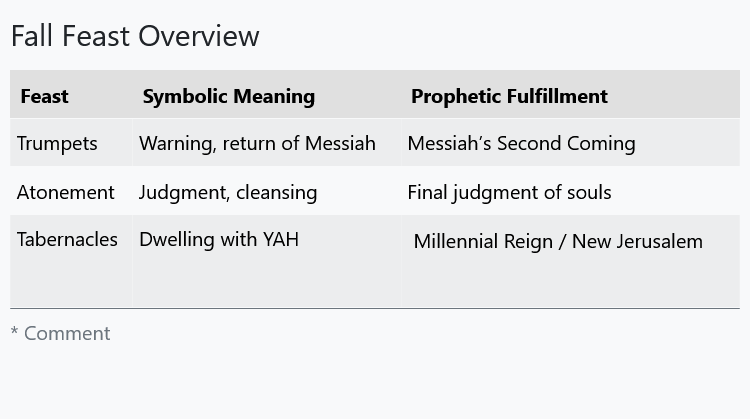
Just as the Spring Feasts pointed to Yahushua’s first coming, the Fall Feasts point to His return. This is the biblical calendar YAH laid out for our instruction—not the Gregorian calendar, and certainly not man-made holidays.
For a good calendar breakdown please go to: Hebrew Calender
Why Hebrew Israelites Must Keep These Feasts
Many people ask, “Do we have to keep these feasts today?”
The answer is a resounding YES. These are forever ordinances.
Leviticus 23:41 (KJV):
“And ye shall keep it a feast unto the ELOHIM seven days in the year… it shall be a statute forever in your generations…”
YAH doesn’t change.
Malachi 3:6 (KJV):
“For I am the YAHUAH, I change not; therefore ye sons of Jacob are not consumed.”
Keeping the feast days does not mean we reject grace or Messiah—it means we honor the commandments that Messiah Himself obeyed. If He kept them, so must we.
How to Prepare for the Fall Feasts
Study the Scriptures – Leviticus 23 is your foundation. Also study Zechariah 14, Revelation 21, and Hebrews 9–10.
Mark the Dates – Learn the biblical calendar (not the Roman one). Use the new moon to determine the 7th month.
Join with the Remnant – Assemble with others keeping Torah. Try not to walk this path alone.
Physically Participate – Blow the shofar, fast on Atonement, and dwell in a booth during Tabernacles.
Spiritually Align – Repent, confess, rejoice. These are more than rituals—they are life.
Final Thoughts: Return to the Ancient Paths
Jeremiah 6:16 (KJV):
“Thus saith the ELOHIM, Stand ye in the ways, and see, and ask for the old paths… and walk therein, and ye shall find rest for your souls.”
The Fall Feast Days are those old paths. They are not Jewish customs—they are divine commands. They reveal the blueprint of what has happened, what is happening, and what is about to unfold.
If you desire to be counted among the righteous remnant of Israel, begin with obedience. The trumpet is sounding. Judgment is near. The Kingdom is coming.
Are you ready?
Shalom
Explore the full Unknown Hebrew Collection for more scripture-based studies.
Stay updated with teachings — follow Unknown Hebrew on Substack.
Have questions? Contact Unknown Hebrew directly.
For a good calendar breakdown please go to: Hebrew Calender