
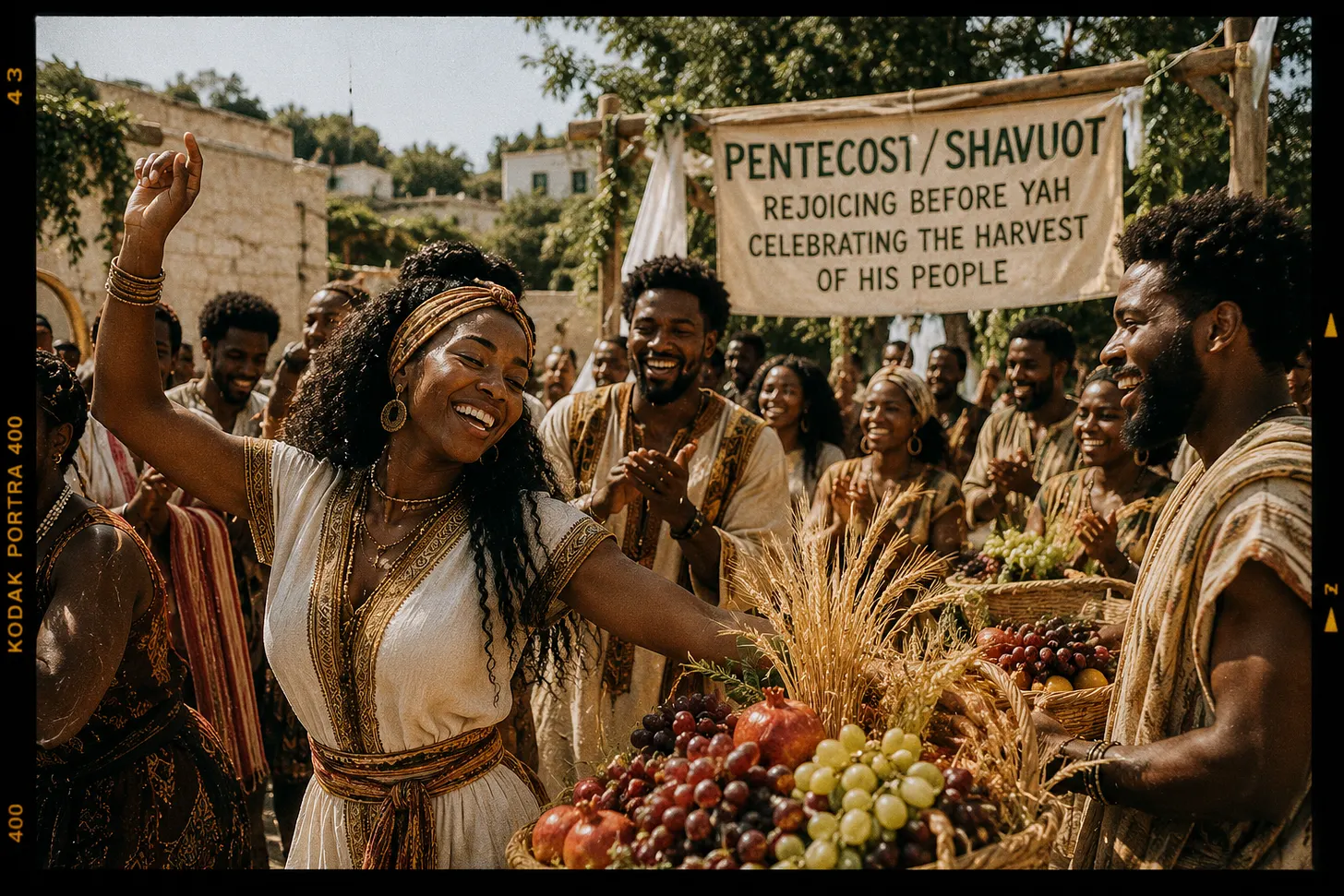
*Shalom Family, we were supposed to have this article come out when many of our people celebrate Pentecost, but because of technical issues, it was not sent out. Instead of leaving this for next time, we wanted to release the article to help our people learn how best to celebrate this day and, hopefully, reflect on YAHUAH and His word. A Feast Filled With Joy Among all of YAH’s appointed times, there is something uniquely joyful about Pentecost. Passover causes us to reflect upon deliverance and redemption. The Feast of Unleavened Bread reminds us to remove sin from our lives. The Day of Atonement calls us to humility and self-examination. Yet Pentecost arrives with an entirely different atmosphere. It is a feast associated with abundance, gratitude, fellowship, provision, and harvest. For many Israelites, it is one of the most anticipated celebrations of the year. As the count toward the Feast of Weeks progresses, there is a growing sense of expectation. Each day brings us closer to another reminder of YAH’s faithfulness. Each day reminds us that the Creator who causes crops to grow is the same Creator who causes spiritual growth within His people. This feast teaches us something that modern society often forgets. Everything all that we have originates from YAH. The food we eat is from Him. The rain that feeds the land comes from Him. The harvest’s increase is also from Him. Our understanding of His Word is granted by Him. The awakening of scattered Israelites comes from Him. The growth of His people is a gift from Him. Pentecost is therefore much more than an agricultural celebration. It is a declaration that YAH remains the source of every blessing. For Israelites living throughout the nations today, this feast carries even deeper meaning. We celebrate it not merely because ancient Israel celebrated it. We celebrate it because it continues teaching the same truths today that it taught thousands of years ago. YAH provides. YAH gathers. YAH increases. YAH blesses. And YAH is still harvesting His people. (See our book, What Every Hebrew Needs to Know about Shavuot: -Feast Keepers- Pentecost, Firstfruits, Feast of Weeks). The Commandment to Keep the Feast of Weeks The Feast of Weeks is not a tradition invented by men. It is not a cultural holiday that emerged through human customs. It is one of the appointed times established by YAH Himself. The instructions appear clearly in the Torah. Leviticus 23:15-21 (KJV) “And ye shall count unto you from the morrow after the sabbath, from the day that ye brought the sheaf of the wave offering; seven sabbaths shall be complete: Even unto the morrow after the seventh sabbath shall ye number fifty days; and ye shall offer a new meat offering unto the ELOHIM. Ye shall bring out of your habitations two wave loaves of two tenth deals: they shall be of fine flour; they shall be baken with leaven; they are the firstfruits unto the ELOHIM. And ye shall offer with the bread seven lambs without blemish of the first year, and one young bullock, and two rams: they shall be for a burnt offering unto the ELOHIM, with their meat offering, and their drink offerings, even an offering made by fire, of sweet savour unto the ELOHIM. Then ye shall sacrifice one kid of the goats for a sin offering, and two lambs of the first year for a sacrifice of peace offerings. And the priest shall wave them with the bread of the firstfruits for a wave offering before the ELOHIM, with the two lambs: they shall be holy to the ELOHIM for the priest. And ye shall proclaim on the selfsame day, that it may be an holy convocation unto you: ye shall do no servile work therein: it shall be a statute for ever in all your dwellings throughout your generations.” Several important truths emerge from this passage. First, YAH established a counting process leading to this feast. Pentecost does not arrive unexpectedly. It is anticipated. It is approached intentionally. The counting itself creates expectation and reminds believers that appointed times do not occur randomly. Second, this feast is described as a holy convocation. Israel was commanded to gather before YAH. Fellowship was built directly into the observance. Third, the feast was connected to firstfruits and harvest. It celebrated increase and provision. Finally, the feast was described as a statute throughout Israel’s generations. For Hebrew Israelites today, this matters greatly. We do not view Pentecost as something abolished. We do not view it as something replaced. We do not view it as something belonging only to ancient history. We view it as one of YAH’s appointed times that continues teaching His people about obedience, gratitude, provision, and redemption. A Celebration of Harvest and Abundance To fully appreciate Pentecost, we must understand the agricultural world in which it was originally observed. Modern people often obtain food without ever considering where it came from. We visit a grocery store, select items from shelves, and return home. The process is so convenient that it becomes easy to forget how dependent human beings remain upon YAH’s provision. Ancient Israel lived much closer to the reality of harvest. The success of a harvest affected everything. A strong harvest meant food. A strong harvest meant stability. A strong harvest meant security. A strong harvest meant life. A failed harvest could create hardship, uncertainty, and suffering. This reality caused the Israelites to recognize something many modern societies overlook. Human effort alone cannot create a harvest. Farmers can plant. Farmers can labor. Farmers can prepare the ground. Yet they cannot command rain, the sunshine, or command the harvest to grow. Only YAH can do those things. This understanding transformed harvest into an act of worship. The Feast of Weeks became a time when Israel collectively acknowledged that the abundance they enjoyed came from the Creator. Every bundle of grain testified to His faithfulness. Every field testified to His provision. Every harvest testified