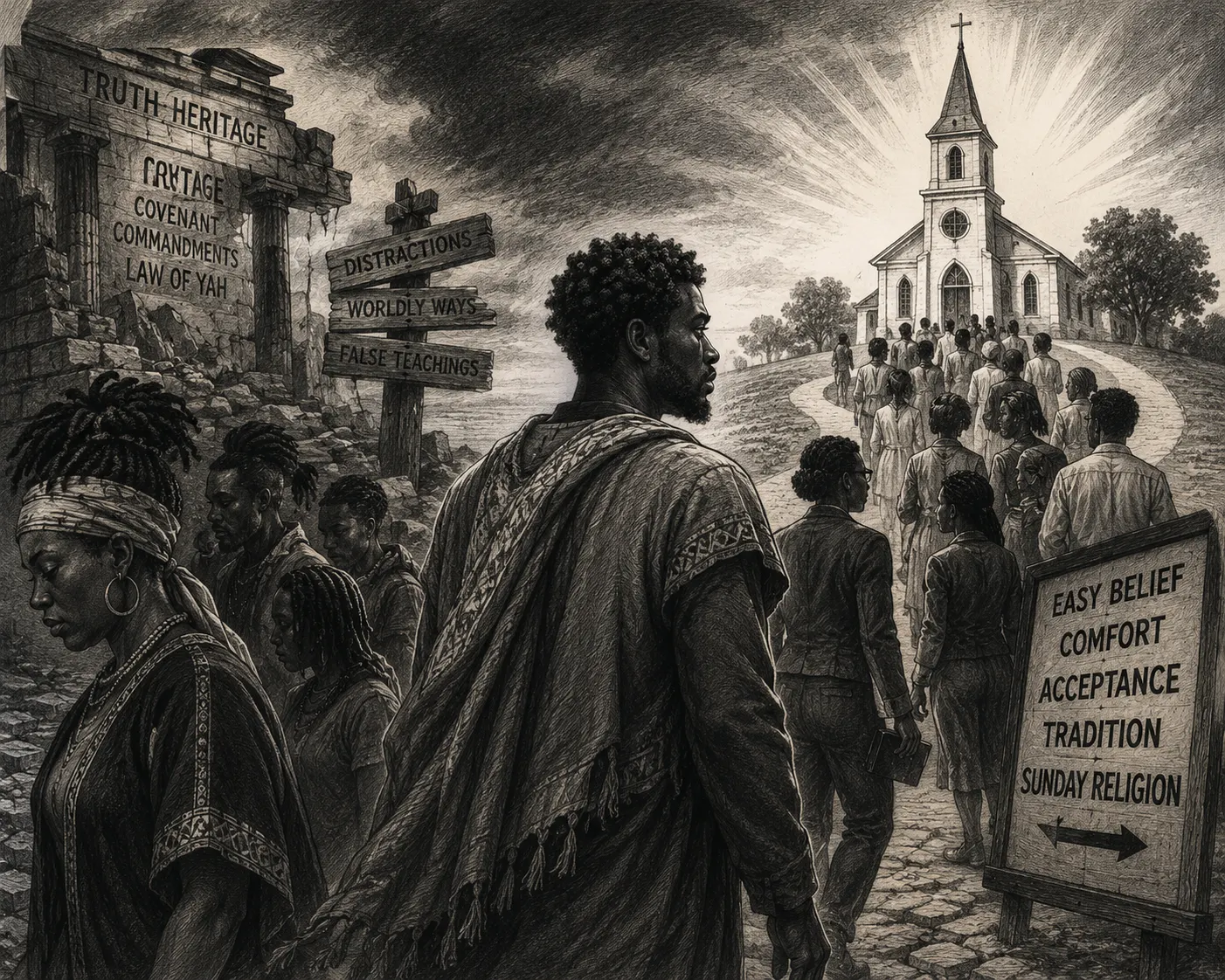

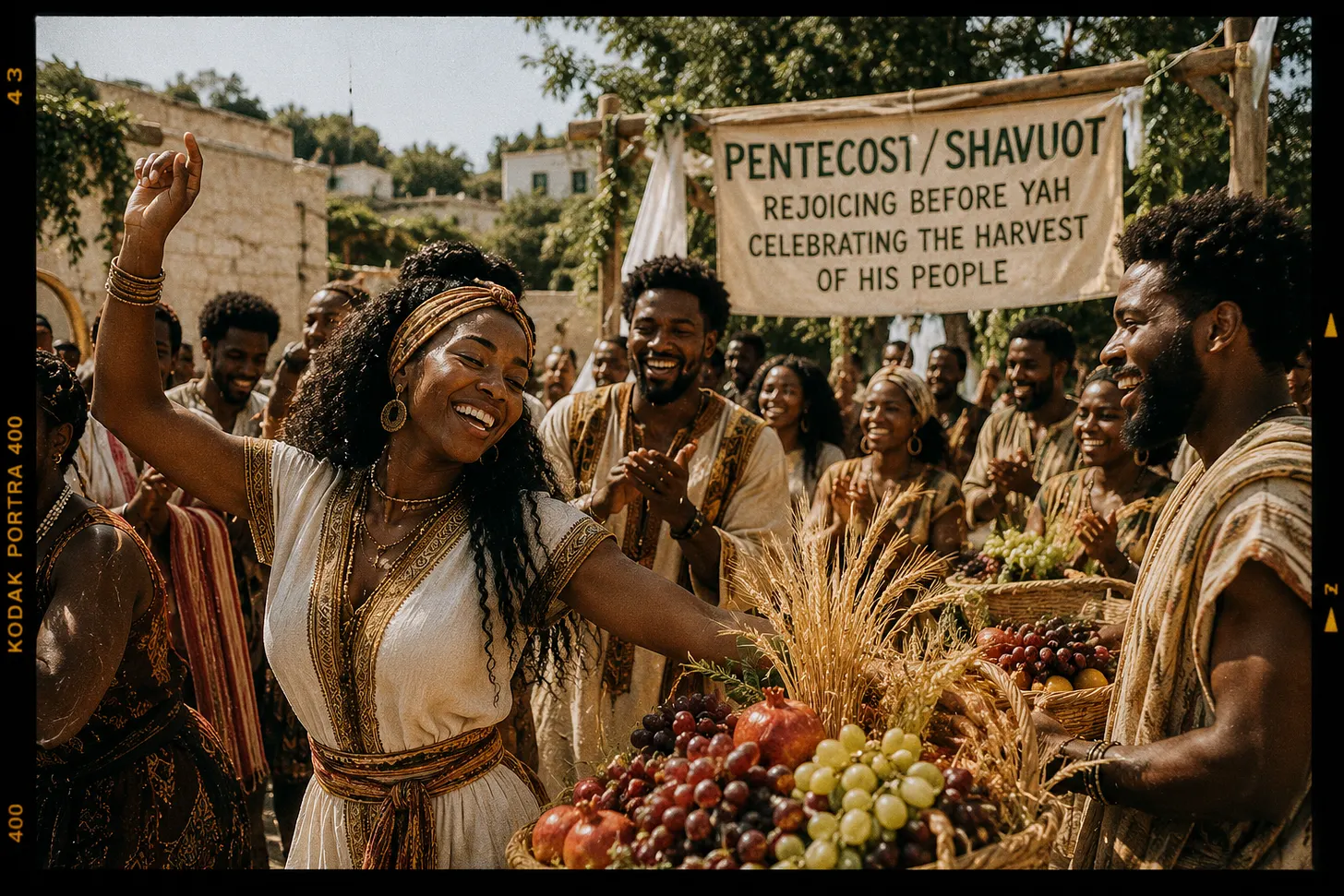
*Shalom Family, we were supposed to have this article come out when many of our people celebrate Pentecost, but because of technical issues, it was not sent out. Instead of leaving this for next time, we wanted to release the article to help our people learn how best to celebrate this day and, hopefully, reflect on YAHUAH and His word.
A Feast Filled With Joy
Among all of YAH’s appointed times, there is something uniquely joyful about Pentecost.
Passover causes us to reflect upon deliverance and redemption. The Feast of Unleavened Bread reminds us to remove sin from our lives. The Day of Atonement calls us to humility and self-examination. Yet Pentecost arrives with an entirely different atmosphere. It is a feast associated with abundance, gratitude, fellowship, provision, and harvest.
For many Israelites, it is one of the most anticipated celebrations of the year.
As the count toward the Feast of Weeks progresses, there is a growing sense of expectation. Each day brings us closer to another reminder of YAH’s faithfulness. Each day reminds us that the Creator who causes crops to grow is the same Creator who causes spiritual growth within His people.
This feast teaches us something that modern society often forgets.
Everything all that we have originates from YAH. The food we eat is from Him. The rain that feeds the land comes from Him. The harvest’s increase is also from Him. Our understanding of His Word is granted by Him. The awakening of scattered Israelites comes from Him. The growth of His people is a gift from Him.
Pentecost is therefore much more than an agricultural celebration. It is a declaration that YAH remains the source of every blessing.
For Israelites living throughout the nations today, this feast carries even deeper meaning. We celebrate it not merely because ancient Israel celebrated it. We celebrate it because it continues teaching the same truths today that it taught thousands of years ago.
YAH provides.
YAH gathers.
YAH increases.
YAH blesses.
And YAH is still harvesting His people.
(See our book, What Every Hebrew Needs to Know about Shavuot: -Feast Keepers- Pentecost, Firstfruits, Feast of Weeks).
The Commandment to Keep the Feast of Weeks
The Feast of Weeks is not a tradition invented by men. It is not a cultural holiday that emerged through human customs. It is one of the appointed times established by YAH Himself.
The instructions appear clearly in the Torah.
Leviticus 23:15-21 (KJV)
“And ye shall count unto you from the morrow after the sabbath, from the day that ye brought the sheaf of the wave offering; seven sabbaths shall be complete:
Even unto the morrow after the seventh sabbath shall ye number fifty days; and ye shall offer a new meat offering unto the ELOHIM.
Ye shall bring out of your habitations two wave loaves of two tenth deals: they shall be of fine flour; they shall be baken with leaven; they are the firstfruits unto the ELOHIM.
And ye shall offer with the bread seven lambs without blemish of the first year, and one young bullock, and two rams: they shall be for a burnt offering unto the ELOHIM, with their meat offering, and their drink offerings, even an offering made by fire, of sweet savour unto the ELOHIM.
Then ye shall sacrifice one kid of the goats for a sin offering, and two lambs of the first year for a sacrifice of peace offerings.
And the priest shall wave them with the bread of the firstfruits for a wave offering before the ELOHIM, with the two lambs: they shall be holy to the ELOHIM for the priest.
And ye shall proclaim on the selfsame day, that it may be an holy convocation unto you: ye shall do no servile work therein: it shall be a statute for ever in all your dwellings throughout your generations.”
Several important truths emerge from this passage.
First, YAH established a counting process leading to this feast. Pentecost does not arrive unexpectedly. It is anticipated. It is approached intentionally. The counting itself creates expectation and reminds believers that appointed times do not occur randomly.
Second, this feast is described as a holy convocation. Israel was commanded to gather before YAH. Fellowship was built directly into the observance.
Third, the feast was connected to firstfruits and harvest. It celebrated increase and provision.
Finally, the feast was described as a statute throughout Israel’s generations.
For Hebrew Israelites today, this matters greatly. We do not view Pentecost as something abolished. We do not view it as something replaced. We do not view it as something belonging only to ancient history.
We view it as one of YAH’s appointed times that continues teaching His people about obedience, gratitude, provision, and redemption.
A Celebration of Harvest and Abundance
To fully appreciate Pentecost, we must understand the agricultural world in which it was originally observed.
Modern people often obtain food without ever considering where it came from. We visit a grocery store, select items from shelves, and return home. The process is so convenient that it becomes easy to forget how dependent human beings remain upon YAH’s provision.
Ancient Israel lived much closer to the reality of harvest. The success of a harvest affected everything.
A strong harvest meant food.
A strong harvest meant stability.
A strong harvest meant security.
A strong harvest meant life.
A failed harvest could create hardship, uncertainty, and suffering.
This reality caused the Israelites to recognize something many modern societies overlook. Human effort alone cannot create a harvest.
Farmers can plant.
Farmers can labor.
Farmers can prepare the ground.
Yet they cannot command rain, the sunshine, or command the harvest to grow.
Only YAH can do those things.
This understanding transformed harvest into an act of worship.
The Feast of Weeks became a time when Israel collectively acknowledged that the abundance they enjoyed came from the Creator.
Every bundle of grain testified to His faithfulness. Every field testified to His provision. Every harvest testified to His mercy. This perspective remains relevant today. Many Israelites living in modern cities no longer work fields or harvest wheat. Yet the underlying lesson remains unchanged.
All of the blessings still come from YAH. Every provision still comes from YAH. All opportunity still comes from YAH. And any increase still comes from YAH. Pentecost teaches gratitude because gratitude naturally follows the recognition that nothing truly belongs to us apart from the blessings of the Most High.
Why Pentecost Is Such a Joyful Feast for Israelites
One of the most beautiful aspects of this feast is the emphasis placed upon rejoicing.
Many people imagine obedience as something burdensome. They imagine the commandments as a collection of restrictions designed merely to limit behavior.
The feast days reveal a very different picture.
YAH commands His people to rejoice; He commands celebration; He commands thanksgiving; He commands fellowship.
Consider the instructions given in Deuteronomy.
Deuteronomy 16:10-11 (KJV)
“And thou shalt keep the feast of weeks unto the YAHUAH thy ELOHIM with a tribute of a freewill offering of thine hand, which thou shalt give unto YAHUAH thy ELOHIM, according as YAHUAH thy ELOHIM hath blessed thee:
And thou shalt rejoice before YAHUAH thy ELOHIM, thou, and thy son, and thy daughter, and thy manservant, and thy maidservant, and the Levite that is within thy gates, and the stranger, and the fatherless, and the widow, that are among you…”
Notice the language carefully.
YAH does not merely permit rejoicing. He commands it. This is remarkable because it reveals something about His character. The Creator does not desire His people to approach His appointed times as though they are attending funerals.
He desires gratitude.
He desires celebration.
He desires fellowship.
He desires joy.
For Hebrew Israelites living in dispersion today, this command carries special significance. Many of us spent years disconnected from our heritage, our identity, and our understanding of Scripture. Many spent years believing traditions that did not originate from YAH.
Yet now we have the opportunity to gather together, celebrate His appointed times, and rejoice in truths that previous generations often never had the opportunity to understand.
That reality alone provides tremendous reason for joy.
We rejoice because YAH awakened us.
We rejoice because He opened our eyes.
We rejoice because He preserved His Word.
We rejoice because He continues gathering His people.
And Pentecost gives us a special opportunity to celebrate all of these blessings together.
(See our books, The Path: Of Righteousness)
The Prophetic Harvest Hidden Within Pentecost
One of the most fascinating aspects of the Feast of Weeks is that its meaning extends far beyond agriculture.
At first glance, Pentecost appears to be a celebration centered upon wheat, grain, and harvest. Certainly those elements are important. They formed the foundation of the feast in ancient Israel. Yet as with many of YAH’s appointed times, there is a deeper prophetic dimension hidden beneath the physical observance.
The physical harvest points toward a greater spiritual harvest.
This pattern appears throughout Scripture.
YAH frequently uses agricultural language to describe His dealings with His people. Planting, sowing, watering, pruning, firstfruits, and harvest all become symbols through which spiritual realities are explained.
All of the chosen of YAH from the prophets, apostles, and the Messiah Himself understood this.
When YAH established harvest celebrations within Israel, He was doing more than regulating agricultural life. He was creating living lessons that would teach future generations about His plan of redemption.
The Feast of Weeks stands as one of the clearest examples of this principle. Ancient Israel looked across fields filled with grain and recognized YAH’s provision. Today, Israelites can look across the nations and recognize something equally remarkable.
YAH is still gathering a harvest.
Not a harvest of wheat or barley.
A harvest of people.
Throughout history, the descendants of Israel have been scattered among the nations exactly as the Scriptures foretold. Generations have passed. Kingdoms have risen and fallen. Entire peoples have forgotten who they are.
Yet despite centuries of dispersion, YAH has never forgotten His people.
Just as a farmer knows the location of every field he has planted, YAH knows where His people have been scattered.
Just as a farmer patiently waits for harvest season, YAH has a timetable for gathering His people.
And Pentecost reminds us of that reality.
The physical harvest becomes a picture of a much larger spiritual harvest taking place across the earth. Every awakened Israelite is evidence that YAH’s harvest continues. Every person returning to the commandments is evidence that YAH’s harvest continues. Every individual rediscovering the covenant is evidence that YAH’s harvest is still going on.
The fields may look different today than they did in ancient Israel, but the principle remains the same.
YAH is still gathering.
YAH is still calling.
YAH is still increasing.
And Pentecost reminds us that the harvest is far from complete.
(See our book, Knowing the Father and the Son: Those who seek the truth will find it)
Acts 2 and the Outpouring of the Ruach Ha’Kodesh
The prophetic significance of Pentecost becomes even more profound when we reach the book of Acts. Many believers know the events of Acts 2 but never stop to consider why they occurred on Pentecost. The timing was not accidental. The outpouring of the Ruach Ha’Kodesh (the Holy Spirit) did not occur on a random day.
It occurred on one of YAH’s appointed feast days.
Acts 2:1-4 (KJV)
“And when the day of Pentecost was fully come, they were all with one accord in one place.
And suddenly there came a sound from heaven as of a rushing mighty wind, and it filled all the house where they were sitting.
And there appeared unto them cloven tongues like as of fire, and it sat upon each of them.
And they were all filled with the Ruach Ha’ Kodesh (Holy Spirit), and began to speak with other tongues, as the Spirit gave them utterance.”
The significance of this event cannot be overstated.
Thousands of Israelites from various nations had gathered in Jerusalem to observe the Feast of Weeks. The city was filled with pilgrims. The feast was already bringing together people from scattered locations.
Then YAH poured out His Spirit.
What happened next was extraordinary.
The message spread. The Gospel reached thousands. People heard the wonderful works of YAH in their own languages. And a tremendous spiritual harvest began.
Later in the chapter we read:
Acts 2:41 (KJV)
“Then they that gladly received his word were baptized: and the same day there were added unto them about three thousand souls.”
Three thousand souls.
On Pentecost. On the feast associated with harvest. This was not coincidence. The physical harvest of ancient Israel was being joined by a spiritual harvest. YAH was showing His people that His redemptive plan extended beyond grain and fields.
He was gathering His people. He was calling Israelites back into covenant. He was increasing His harvest.
This event remains deeply meaningful for us Hebrew Israelites today.
Acts 2 demonstrates that Pentecost is not merely a memorial of ancient agriculture. It is also a testimony to YAH’s continuing work among His people. The same Spirit that empowered the apostles continues guiding Israelites today.
The same ELOHIM who gathered people then continues gathering people now.
The same harvest that began centuries ago continues unfolding before our eyes.
Pentecost and the Future Gathering of Israel
One of the reasons Pentecost produces such joy among Israelites is because it reminds us that YAH is not finished with His people. The world often presents history as though Israel’s story has already been completed.
Scripture says otherwise. The prophets repeatedly describe a future gathering, restoration, and redemption.
Again and again, YAH promises to regather His scattered people.
Isaiah 11:12 (KJV)
“And he shall set up an ensign for the nations, and shall assemble the outcasts of Israel, and gather together the dispersed of Judah from the four corners of the earth.”
This promise remains one of the most encouraging themes in Scripture.
Israel may be scattered.
Israel may be oppressed.
Israel may be hidden among the nations.
Yet YAH has never abandoned His covenant.
Pentecost serves as a yearly reminder of this reality. Harvest only occurs because planting occurred first. The existence of a harvest proves that seeds were planted. Likewise, the awakening of Israelites throughout the world reminds us that YAH’s promises remain active.
Every person returning to Scripture.
Every family learning the commandments.
Every believer rediscovering their identity.
Every congregation gathering in truth.
All of these things point toward the larger harvest still to come. For this reason, Pentecost is not merely a celebration of the past. It is a celebration of the future.
It reminds us that YAH’s plan is still unfolding.
It reminds us that prophecy is still moving forward.
It reminds us that the harvest is not finished.
The fields are still being gathered. The work is still underway. The promises are still being fulfilled. And that reality fills this feast with hope.
(See our book, What Every Hebrew Needs to Know about Shavuot: -Feast Keepers- Pentecost, Firstfruits, Feast of Weeks).
Why Pentecost Matters for Israelites Today
Some people ask why Israelites should continue celebrating Pentecost in the modern world.
The answer becomes obvious once we understand the feast itself.
Pentecost reminds us of four key things: That YAHUAH provides all of our sustenance, He gathers His people, He blesses those people, and He keeps His promises.
The world offers countless celebrations that focus upon human achievement. Pentecost focuses upon divine provision. The world encourages people to celebrate themselves. Pentecost encourages us to celebrate YAH. The world teaches self-sufficiency. Pentecost teaches dependence upon the Creator.
In a culture increasingly disconnected from Scripture, these lessons become more important than ever. Many people spend their lives pursuing wealth without gratitude. Success without humility. Achievement without worship.
Pentecost calls believers back to a different perspective.
Everything we possess comes from YAH.
Every blessing comes from YAH.
Every opportunity comes from YAH.
Every increase comes from YAH.
And because these truths remain unchanged, the feast remains relevant. The Israelites who kept Pentecost thousands of years ago needed these reminders. The Israelites scattered among the nations today need them just as much.
A Feast of Joy, Harvest, and Hope
Among all of YAH’s appointed times, Pentecost stands as one of the most joyful. It reminds us that the Creator of heaven and earth remains actively involved in the lives of His people.
He causes harvests to grow, He provides increase, He pours out blessings, He gathers His people, and He fulfills His promises.
The physical harvest celebrated in ancient Israel pointed toward deeper realities that continue unfolding today. The gathering of grain pointed toward the gathering of people. The firstfruits pointed toward greater harvests yet to come. The rejoicing of ancient Israelites pointed toward the rejoicing of Israelites who witness YAH’s hand at work throughout the earth.
For Hebrew Israelites, Pentecost is therefore much more than a historical observance.
It is a celebration of provision, restoration, awakening, of covenant and of hope of the prophecies being fullfilled about His people.
Each year the feast reminds us that YAH is still gathering His people from among the nations. He is still increasing His harvest. He is still fulfilling His promises exactly as He said He would.
And that reality gives us every reason to rejoice before Him.
As we gather with family, friends, and fellow Israelites during this appointed time, we are participating in something far greater than a yearly tradition.
We are celebrating the faithfulness of YAH.
We are celebrating His harvest.
And we are celebrating the certainty that the One who began gathering His people will complete the work He has promised to do. Until that final harvest arrives, Pentecost remains a beautiful reminder that the fields belong to YAH, the harvest belongs to YAH, and His people belong to Him.
Shalom,
Keep In Touch
Explore the full Unknown Hebrew Collection for more scripture-based studies.
Stay updated with teachings — follow Unknown Hebrew on Substack.
Have questions? Contact Unknown Hebrew directly.