
A Trend That Should Concern Every Israelite
One of the most unsettling trends many believers have noticed in recent years is the growing number of Israelites who are returning to Christianity after once embracing what they believed was biblical truth. Some were Sabbath keepers. Some observed the feast days. Some taught the dietary laws. Some openly defended Torah and challenged mainstream church doctrine. Yet today many of those same individuals have gone back to the churches they once left, the traditions they once questioned, and the doctrines they once rejected.
For those who remain committed to the commandments, this trend raises difficult questions. How can someone spend years studying Scripture and then walk away from what they once believed was truth? How can a person who once defended the Sabbath later argue against it? How can someone who once taught obedience suddenly begin teaching that obedience is unnecessary?
The easy answer is to simply accuse such people of deception, weakness, or rebellion. Certainly, in some cases those accusations may be justified. However, if we stop there, we miss an opportunity to learn something important. The reality is that every warning in Scripture exists for a reason. When we witness others falling away, we should not only ask why they left. We should also ask what their departure reveals about the spiritual challenges facing all believers in these last days.
The truth is that discovering truth and remaining faithful to truth are two very different things.
Many people assume that once someone learns the truth, the battle is over. Scripture teaches the opposite. Learning the truth often marks the beginning of the battle rather than the end of it. The moment a person begins walking a different path from the world around them, new pressures emerge. New temptations appear. New forms of opposition arise. The Israelite who once thought the greatest challenge was finding the truth soon discovers that the greater challenge is remaining faithful to it.
This is one reason the Scriptures place such a strong emphasis on endurance. The Bible rarely praises people simply for beginning well. Instead, it repeatedly focuses on those who remained faithful when obedience became difficult. And has reverence for the people who kept their obedience to YAHUAH to their dying breath.
(See our books, The Path: Of Righteousness)
The Bible Never Promised That Everyone Who Finds Truth Would Stay With It
One assumption many believers make is that once someone sees the truth clearly, they will never abandon it. On the surface this seems reasonable. If something is true, why would anyone knowingly walk away from it?
Yet the Bible repeatedly shows that knowledge alone does not guarantee faithfulness.
Ancient Israel witnessed miracles in Egypt, saw the Red Sea divided, ate manna from heaven, and heard the voice of YAH at Sinai. Yet despite experiencing things most people can scarcely imagine, many still rebelled. Their problem was not lack of evidence. Their problem was that knowledge and obedience are not the same thing.
The same principle appears throughout Scripture.
Judas walked with the Messiah and heard His teachings firsthand, yet still betrayed Him.
Demas labored alongside Paul, yet eventually abandoned the work.
Entire generations of Israelites witnessed the power of YAH and still turned aside.
The lesson is sobering. A person can be exposed to the truth without allowing it to fully transform their heart.
The Apostle Paul warned believers that a great departure from truth would occur before the end.
2 Thessalonians 2:3 (KJV)
“Let no man deceive you by any means: for that day shall not come, except there come a falling away first…”
This warning is significant because Paul is not describing people who never knew anything about Scripture. He is describing people who were once connected to truth and later departed from it.
That reality should humble every believer.
Sometimes people discuss the falling away as though it only applies to others. They imagine it happening somewhere outside of their own circles. Yet Paul’s warning is valuable precisely because it reminds us that no one should become spiritually complacent. The Israelite who assumes they could never be deceived often becomes vulnerable to deception because they stop guarding their heart carefully.
The Scriptures never teach believers to place confidence in themselves. Instead, they continually call us to vigilance, humility, prayer, and dependence upon YAH.
(See our book, Peace Be Still John 14:27: Peace For Everyday Living, His Shalom)
What Happens When the Excitement of Discovering Truth Begins to Fade?
What often surprises believers is that the greatest threat to their faith rarely arrives when they are weak. More often it arrives when they feel strongest.
When most people first discover what they believe to be biblical truth, there is an almost overwhelming sense of certainty. Scriptures that once seemed confusing suddenly appear obvious. Questions that lingered for years seem to answer themselves. Entire sections of the Bible begin fitting together in ways they never had before. It is difficult to describe that experience to someone who has never gone through it. For many Israelites, it feels less like learning something new and more like waking up.
In those moments it is easy to imagine that the journey ahead will be relatively straightforward. After all, once a person sees the truth, why would they ever want to leave it? The answer seems self-evident. If something is true, then surely the natural response is to hold onto it.
Yet experience shows that reality is rarely that simple.
The difficulty is that spiritual life cannot survive forever on discovery. Discovery is powerful, but it is temporary by nature. Eventually every revelation becomes familiar. Every doctrine becomes something you have heard before. Even the most profound truths eventually become part of ordinary life.
This is where many believers encounter a challenge they never anticipated. The excitement that once carried them forward begins to settle, and for the first time they find themselves walking by conviction rather than enthusiasm.
At first the difference hardly seems noticeable. The believer still keeps the Sabbath. They still study. They still pray. Outwardly very little has changed. Yet inwardly something important is happening. They are learning whether their relationship with truth was built upon the joy of discovering it or the commitment required to live it.
That distinction becomes more important with every passing year.
Most people enjoy discovering something new. There is a natural reward built into learning. The mind becomes energized. Curiosity is satisfied. Progress feels visible. Obedience, however, often works differently. Obedience is repetitive. It asks a person to continue doing the same thing long after the excitement has faded.
This is one reason why so much of Scripture focuses on perseverance rather than inspiration.
The heroes of faith were not people who experienced a brief moment of conviction. They were people who continued long after that moment had passed.
Abraham was not tested when he first received the promise. He was tested while waiting for it.
Noah was not tested when he received instructions about the ark. He was tested during the years spent building it.
Israel was not tested when they left Egypt. They were tested in the wilderness afterward.
Again and again the Scriptures reveal the same pattern. The real challenge is not beginning. The real challenge is continuing.
(See our book, Symbolic Meaning of Water Baptism)
The Emotional Cost of Walking Away From the Crowd
The longer a person remains on this journey, the more they begin to discover that truth has a way of separating them from the world around them.
Most Israelites expect opposition from obvious enemies. They expect resistance from unbelievers or from people openly hostile to Scripture. What many do not expect is how often the greatest pressures come from ordinary relationships.
A person may discover that conversations with family members become increasingly difficult. Traditions they once participated in without a second thought now carry spiritual implications. Decisions that once seemed simple suddenly require conviction.
The difficulty is not merely theological.
The difficulty is relational.
Human beings were created for connection. We naturally desire acceptance, community, and belonging. Those desires are not sinful. They are part of how YAH created us.
The challenge arises when those desires begin pulling in a different direction than our convictions.
It is one thing to believe something.
It is another thing entirely to continue believing it when that belief creates distance between you and the people whose acceptance you value most.
This is one reason the words of the Messiah can feel so heavy.
Matthew 10:36-37 (KJV)
“And a man’s foes shall be they of his own household. He that loveth father or mother more than me is not worthy of me…”
The Messiah was not merely making a theological observation. He was preparing Israelites for a reality they would eventually face. There will be moments when obedience creates tension with people we love.
Over time, that tension can become exhausting.
Many people do not walk away from the truth because they stopped believing it. They walk away because they became tired of carrying the weight that came with it.
Some become weary of explaining themselves.
Some become weary of standing alone.
Some become weary of criticism.
Some become weary of feeling different.
Long before doctrine changes, fatigue often begins accumulating.
And that fatigue becomes one of the quiet forces working beneath the surface of the falling away.
Long before a person publicly changes what they believe, something is often happening beneath the surface that few people can see. This is one of the reasons the falling away can be so difficult to understand from the outside. Observers usually notice the final outcome. They see someone return to Christianity. They hear a public statement. They watch a person abandon convictions that once seemed deeply rooted.
What they do not see is the internal process that often unfolded over months or even years before that moment ever arrived.
The visible departure is usually the final chapter of a much longer story.
This reality becomes especially important when we begin considering the role disappointment plays in a person’s spiritual life.
There is a tendency among believers to assume that truth and disappointment occupy separate categories. We imagine that if the truth is true, then disappointment should have no effect upon it. From a purely intellectual perspective, that sounds reasonable. Truth does not become false simply because someone misrepresents it. The commandments do not become less true because someone fails to keep them. Scripture does not become less reliable because a teacher behaves hypocritically.
Yet human beings rarely process life through logic alone.
We experience life emotionally.
We experience it relationally.
We experience it through trust, expectations, hopes, and disappointments.
Because of this, what appears to be a doctrinal problem is often something much deeper.
Many people who eventually begin questioning the truth are not initially struggling with Scripture at all.
They are struggling with people.
This distinction matters because it helps explain why some departures seem so sudden.
An Israelite may spend years learning from a teacher they respect. They may spend years participating in a congregation they trust. They may spend years investing themselves emotionally in a community that appears healthy and stable.
Then something changes.
Perhaps a leader falls into sin.
Perhaps financial corruption is exposed.
Perhaps pride becomes impossible to ignore.
Perhaps serious doctrinal conflicts emerge.
Perhaps relationships fracture.
Whatever the details may be, the result is often the same.
The Israelite suddenly finds themselves confronting a reality they never expected.
The people they trusted are not who they thought they were.
At first, this realization often produces confusion more than doubt. The person may not immediately question Scripture. They may not immediately question their beliefs. Instead, they begin asking questions about the people who helped shape those beliefs.
How could this happen?
How did I not see it?
What else might I have been wrong about?
Those questions are natural.
In many ways, they are healthy. Periods of examination and self-reflection can strengthen an Israelite when approached correctly. The danger emerges when disappointment slowly transforms into cynicism. Cynicism is one of the most deceptive spiritual conditions because it often disguises itself as wisdom.
The cynical person believes they are becoming more discerning.
The cynical person believes they are becoming harder to deceive.
The cynical person believes they are finally seeing reality clearly.
Yet what is often happening is something very different.
Pain begins shaping perception.
A wound that originated in one place gradually spreads into others. What began as disappointment with a single leader becomes suspicion toward leadership itself; what began as distrust of one ministry becomes distrust of ministries in general.
What began as frustration with specific people becomes frustration with believers as a whole.
Over time, cynicism creates a lens through which everything is viewed. This is why disappointment can become so spiritually dangerous. The problem is not that disappointment exists.
Every Israelite will experience disappointment.
Every congregation contains imperfect people.
Every teacher has weaknesses.
Every ministry has limitations.
The problem arises when disappointment becomes the foundation upon which a person begins interpreting everything else. The Scriptures repeatedly warn against placing ultimate confidence in human beings for precisely this reason.
Not because teachers are unnecessary; Not because fellowship is unimportant. But because people will always disappoint us eventually.
The prophet Jeremiah wrote:
Jeremiah 17:5 (KJV)
“Thus saith the ELOHIM; Cursed be the man that trusteth in man, and maketh flesh his arm…”
This verse is often misunderstood.
Jeremiah is not condemning all trust between human beings. Such a reading would make meaningful relationships impossible. Rather, he is exposing the danger of building our spiritual foundation upon something that was never designed to support it.
Human beings make poor foundations because human beings inevitably fail.
Only YAH remains constant. Only His Word remains constant. Only His character remains unchanged.
This is one reason the failures of men never altered the truth throughout Scripture.
David’s failures did not invalidate the commandments. Solomon’s compromises did not invalidate wisdom. The corruption of priests did not invalidate the covenant. The weakness of men never changed the character of YAH.
Yet when disappointment strikes, it can feel as though everything has changed.
This is because disappointment often affects more than our thinking. It affects our affections. It affects our trust. It affects our willingness to remain vulnerable.
And ultimately, it affects the condition of the heart.
Perhaps this is why the Scriptures place such extraordinary emphasis upon guarding the heart.
The writer of Proverbs declared:
Proverbs 4:23 (KJV)
“Keep thy heart with all diligence; for out of it are the issues of life.”
This verse becomes increasingly profound the longer one reflects upon it.
The heart influences far more than emotions. It influences priorities, desires, and loyalties. It influences what we trust and what we fear. Long before a person’s doctrine changes, something is often changing within the heart itself.
This is why two people can experience similar disappointments and emerge in completely different places.
One becomes more dependent upon Scripture.
The other becomes more dependent upon skepticism.
One becomes more humble.
The other becomes more cynical.
One draws closer to YAH.
The other slowly drifts away.
The circumstances may appear similar.
The outcomes are radically different.
The difference often lies in what the experience produced in them. This realization brings us to one of the deepest questions in the entire discussion.
If knowledge alone cannot protect a believer from falling away, and if disappointment can influence the heart so profoundly, then what is it that ultimately sustains faithfulness over the course of a lifetime?
Why do some believers remain steadfast despite rejection, loneliness, betrayal, disappointment, and hardship while others gradually drift away?
The answer may have less to do with what a person knows and more to do with what they love.
And that may be where the real battle has been taking place all along.
(See our book, Song of Solomon: A Complete Breakdown)
Why the Battle Is Ultimately About What We Love
The idea that faithfulness is ultimately connected to love may seem surprisingly simple at first. In fact, it is so simple that many believers overlook its significance. We tend to assume that spiritual strength comes primarily from knowledge. The more a person learns, the stronger they become. The more doctrines they understand, the more secure their foundation becomes. The more information they accumulate, the less likely they are to be deceived.
There is certainly some truth in that way of thinking. Ignorance has never been a virtue. The Scriptures repeatedly encourage believers to seek wisdom, understanding, and discernment. Yet if knowledge alone were enough to preserve faithfulness, the history recorded in the Bible would look very different.
Again and again, Scripture presents us with people who possessed tremendous knowledge yet still made disastrous decisions.
Ancient Israel knew the commandments. They knew the covenant. They knew the miracles YAH had performed on their behalf. They knew the consequences of disobedience.
Yet knowledge alone did not prevent rebellion.
This pattern appears so consistently throughout Scripture that it forces us to ask a deeper question.
If knowledge is not enough, what is missing?
The answer begins to emerge when we examine the way the Scriptures speak about the heart.
Modern culture often treats the heart as little more than a symbol of emotion. In the biblical worldview, however, the heart occupies a much more central role. The heart represents the inner life or soul of a person. It is the place where desires are formed, where loyalties take root, and where priorities are established. Long before behavior becomes visible, something is usually happening within the heart.
This is why the Messiah so often directed attention toward what people loved rather than simply what they knew.
One of the most revealing statements He ever made appears in the Sermon on the Mount.
Matthew 6:21 (KJV)
“For where your treasure is, there will your heart be also.”
The simplicity of this statement is easy to underestimate. The Messiah is revealing a principle that affects every human being. People move toward what they treasure. People protect what they treasure. People sacrifice for what they treasure. People organize their lives around what they treasure. The question is not whether a person has a treasure. The question is what that treasure actually is.
This principle helps explain why two believers can possess similar knowledge yet travel in completely different directions over time.
Both may understand the Sabbath.
Both may understand the feast days.
Both may understand prophecy.
Both may understand the commandments.
Yet years later, one remains steadfast while the other has drifted away.
Why?
Because information and affection are not the same thing.
Knowledge can tell a person what is true.
It cannot automatically make them treasure what is true.
This distinction may be one of the most overlooked realities in modern religious life. Many people spend years pursuing information while neglecting affection.
They learn doctrine.
They learn history.
They learn prophecy.
They learn arguments.
They learn answers.
Yet they never stop to consider whether their love for YAH is growing alongside their knowledge.
Over time this creates a subtle danger. A person’s understanding may expand while their affection remains unchanged. Their mind becomes full. Their heart remains vulnerable. And the result is a faith that appears strong from a distance but lacks the roots necessary to survive prolonged difficulty.
This is one reason why the greatest commandment is not a commandment about knowledge.
When asked about the most important commandment, the Messiah did not respond by emphasizing information.
He responded by emphasizing love.
Matthew 22:37 (KJV)
“YAHUSHUA said unto him, Thou shalt love YAHUAH thy ELOHIM with all thy heart, and with all thy soul, and with all thy mind.”
The more one reflects upon this commandment, the more remarkable it becomes. The Messiah is not merely calling for agreement. He is not merely calling for understanding. He is calling for devotion.
The heart.
The soul.
The mind.
Every dimension of life is involved.
This reveals something profound about faithfulness. Faithfulness is not sustained primarily by information. Faithfulness is sustained by devotion. People endure hardship for what they love. People remain loyal to what they love. People continue pursuing what they love even when doing so becomes difficult.
This is true in virtually every area of life.
A parent sacrifices for a child because they love that child. A husband remains committed to his wife because he loves her. A person dedicates years to a craft because they love it.
Love creates perseverance.
Love creates endurance.
Love creates resilience.
The same principle applies spiritually.
When truth becomes precious to a person, faithfulness begins operating from a different source. Obedience is no longer sustained merely by obligation.
It is sustained by affection.
Prayer becomes more than a duty. Study becomes more than a task. The commandments become more than rules. Everything begins flowing from relationship rather than mere responsibility.
This is one reason the Psalms speak so frequently about delight. The Psalmist does not merely agree with the law.
He delights in it.
Psalm 1:1-2 (KJV)
“Blessed is the man that walketh not in the counsel of the ungodly…But his delight is in the law of the ELOHIM; and in his law doth he meditate day and night.”
The word delight reveals something important.
The law is not merely understood.
It is cherished.
It is treasured.
It occupies a special place within the heart.
This kind of affection creates stability because it survives circumstances that often destroy mere enthusiasm. Enthusiasm is powerful but temporary.
Affection is deeper.
A person can remain enthusiastic for a season. A person remains devoted for a lifetime. Perhaps this explains why some believers continue walking through disappointment, rejection, loneliness, and hardship without abandoning the truth.
Their relationship with the truth has moved beyond information.
The truth has become precious to them.
They do not merely know it.
They love it.
And once truth becomes something a person genuinely loves, abandoning it becomes far more difficult.
Because in the end, people rarely walk away from what they truly treasure. Which means the battle of the last days may not primarily be a battle over information at all.
It may be a battle over affection.
A battle over what people love.
A battle over what they treasure.
A battle over whether truth remains precious when the cost of holding onto it becomes increasingly high.
And that battle is taking place within every Israelite, whether they recognize it or not.
(See our book, The Chosen Seed: Predestination)
Why Endurance Is More Important Than Excitement
If what a person loves ultimately determines the direction of their life, then it becomes easier to understand why the Scriptures place such extraordinary emphasis upon endurance. At first glance, endurance may not appear to be one of the more exciting themes in the Bible. It lacks the drama of prophecy. It lacks the intrigue of hidden mysteries. It lacks the emotional intensity that often accompanies stories of miracles and deliverance.
Yet the longer one studies Scripture, the more apparent it becomes that endurance occupies a central place in the life of every faithful servant of YAH.
Perhaps that is because endurance reveals something that moments of excitement never can.
Anyone can be faithful for a day.
Anyone can be faithful for a week.
Anyone can be faithful during a season when everything feels new and inspiring.
The greater question is what happens after the excitement fades.
What happens when the answers do not arrive as quickly as expected?
What happens when years pass and the struggles remain?
What happens when the prayers continue but the circumstances seem unchanged?
What happens when obedience becomes ordinary?
These are the moments where endurance begins to reveal itself.
One of the challenges modern believers face is that we often consume the stories of Scripture too quickly. We read entire decades in a matter of minutes. We move from promise to fulfillment so rapidly that we sometimes forget how much waiting occurred in between.
When we read about Abraham, we know how the story ends.
Abraham did not.
When we read about Joseph, we know that his suffering will eventually give way to exaltation.
Joseph did not.
When we read about David, we know that the shepherd boy will eventually become king.
David did not.
What these men possessed was not merely knowledge.
It was endurance.
And endurance is often formed in places where certainty is absent.
This is one reason faith and endurance are so closely connected throughout Scripture.
Faith is often misunderstood as intellectual agreement. Many people think faith simply means believing that YAH exists or believing that His promises are true. While those things are certainly part of faith, the biblical definition reaches much deeper.
Faith reveals itself most clearly when certainty is incomplete. Faith reveals itself when circumstances provide reasons to doubt.
Faith reveals itself when a person continues walking forward despite not being able to see the entire path ahead.
Paul, in the book of Hebrews, captured this beautifully:
Hebrews 11:1 (KJV)
“Now faith is the substance of things hoped for, the evidence of things not seen.”
This verse is familiar to many Israelites, yet its implications are profound.
Faith concerns things not seen. Not things already visible; Not things already fulfilled; Not things already resolved.
Faith operates in the space between promise and fulfillment.
That space can be uncomfortable.
It can be frustrating.
It can be lonely.
It can also be long.
This is why endurance becomes necessary. Without endurance, faith remains shallow.
Without endurance, conviction remains untested.
Without endurance, devotion never has the opportunity to mature.
The people we admire most throughout Scripture are rarely those who experienced brief moments of faithfulness. They are the individuals who remained faithful over extended periods of time.
They continued believing when answers were delayed.
They continued obeying when obedience was costly.
They continued trusting when circumstances appeared unfavorable.
And perhaps most importantly, they continued loving YAH when doing so required sacrifice. This sheds new light on the warning concerning the falling away.
Many people imagine apostasy as a dramatic event. They picture someone suddenly abandoning everything they once believed. Certainly, there are instances where such abrupt departures occur.
More often, however, the process is gradual.
A person becomes tired.
The burdens accumulate.
The disappointments accumulate.
The distractions accumulate.
The years pass.
Little by little, the resolve that once seemed unshakable begins to weaken.
This is one reason why spiritual decline often goes unnoticed until it has progressed much further than anyone realized.
The visible departure usually occurs long after the internal drift began.
Long before a person stops attending fellowship with YAHUAH, something may have changed within the heart.
Long before a person abandons a commandment, something may have changed within their affections.
Long before a person publicly rejects the truth, something may have changed within their priorities.
The final decision often receives the attention.
The gradual process that produced it often goes unnoticed.
Perhaps this is why the Messiah’s warnings regarding endurance carry such weight.
Matthew 24:13 (KJV)
“But he that shall endure unto the end, the same shall be saved.”
These words are remarkably simple. The Messiah does not say that the one who discovers the truth will be saved. He does not say that the one who learns the most information will be saved. He does not say that whoever wins the most debates will be saved.
He points to endurance.
The reason becomes increasingly clear the longer one reflects upon the nature of discipleship.
Discovery is important.
Knowledge is important.
Understanding is important.
But none of those things automatically guarantee faithfulness.
Faithfulness is proven over time. Faithfulness reveals itself through consistency. Faithfulness continues long after the excitement associated with discovery has faded.
This is why the Messiah described discipleship in daily terms rather than occasional ones.
Luke 9:23 (KJV)
“And he said to them all, If any man will come after me, let him deny himself, and take up his cross daily, and follow me.”
The word daily changes everything. Many people imagine faithfulness as a series of dramatic moments. Scripture often presents it as a collection of ordinary decisions repeated over long periods of time.
A prayer offered when no one is watching.
A temptation resisted when compromise appears easier.
A Sabbath honored when it would be more convenient to ignore it.
A commandment obeyed when obedience carries a cost.
These moments rarely seem extraordinary when they occur.
Yet over time they shape the direction of an entire life.
The Israelite who endures until the end is not necessarily the one who experienced the most dramatic spiritual moments. More often, it is the one who continued making faithful decisions long after those moments had passed.
It is the Israelite who remains devoted during ordinary seasons. The Israelite who continued praying when prayer felt routine. The Israelite who continued studying no longer felt excited. The Israelite who continued obeying when obedience seemed unnoticed. Because in the end, endurance is not merely surviving.
Endurance is continuing to love what is true when countless forces are encouraging you to love something else. And perhaps that brings us back to the central theme running throughout this entire discussion.
The great falling away is not merely a story about deception.
It is not merely a story about false doctrine.
It is not merely a story about false teachers.
At its deepest level, it is a story about competing loves.
A story about competing loyalties.
A story about whether truth remains precious enough to hold onto when the cost of holding onto it becomes real. The Israelites who remain faithful until the end are not necessarily those who never experienced disappointment, loneliness, confusion, or hardship.
They are the Israelites who continued to love the truth through all those things. And that distinction may explain why some remain steadfast while others drift away.
Not because they knew more.
Not because they were stronger.
But because what they loved remained unchanged.
(See our book, Knowing the Father and the Son: Those who seek the truth will find it)
The Difference Between Seeing the Truth and Loving It
As we come to the end of this discussion, it is worth returning to the question that quietly sits beneath everything we have examined.
Why do some people remain faithful while others fall away?
At first, the answer appears obvious. Many assume that those who remain simply possess greater knowledge. They understand more Scriptures. They have stronger doctrine. They have studied more diligently. They are better equipped to defend their beliefs against criticism and opposition.
There is certainly value in knowledge. Throughout this article, we have repeatedly seen the importance of studying the Word, growing in understanding, and becoming grounded in Scripture. Yet if knowledge alone were the answer, the warnings about the falling away would be unnecessary.
The reality is that many people who leave the truth are not ignorant people.
Many have studied extensively.
Many can quote Scripture.
Many understand prophecy.
Many understand the commandments.
Many have spent years teaching others.
This reality forces us to confront something that may initially feel uncomfortable. Knowledge alone cannot explain why one person remains faithful while another departs.
Something deeper is involved.
As we have seen, the Scriptures repeatedly direct our attention toward the heart.
Not because doctrine is unimportant.
Not because understanding is unnecessary.
But because the heart ultimately determines what a person does with the truth they possess.
A person may know many things and still choose another path or person may understand many things and still drift away. Another reason could be that a person may agree with many truths intellectually while allowing their affections to move elsewhere.
This is why the great falling away should never be viewed merely as a battle of information.
It is a battle of devotion.
It is a battle of priorities.
It is a battle of affection.
And perhaps most of all, it is a battle over what occupies the highest place within a person’s life.
Throughout history, YAH’s people have faced this same challenge in different forms.
The names of the idols change, the worldly pressures change, the physical, mental, and spiritual circumstances change. Yet the underlying struggle remains remarkably similar. Something continually competes for the place that belongs to YAH.
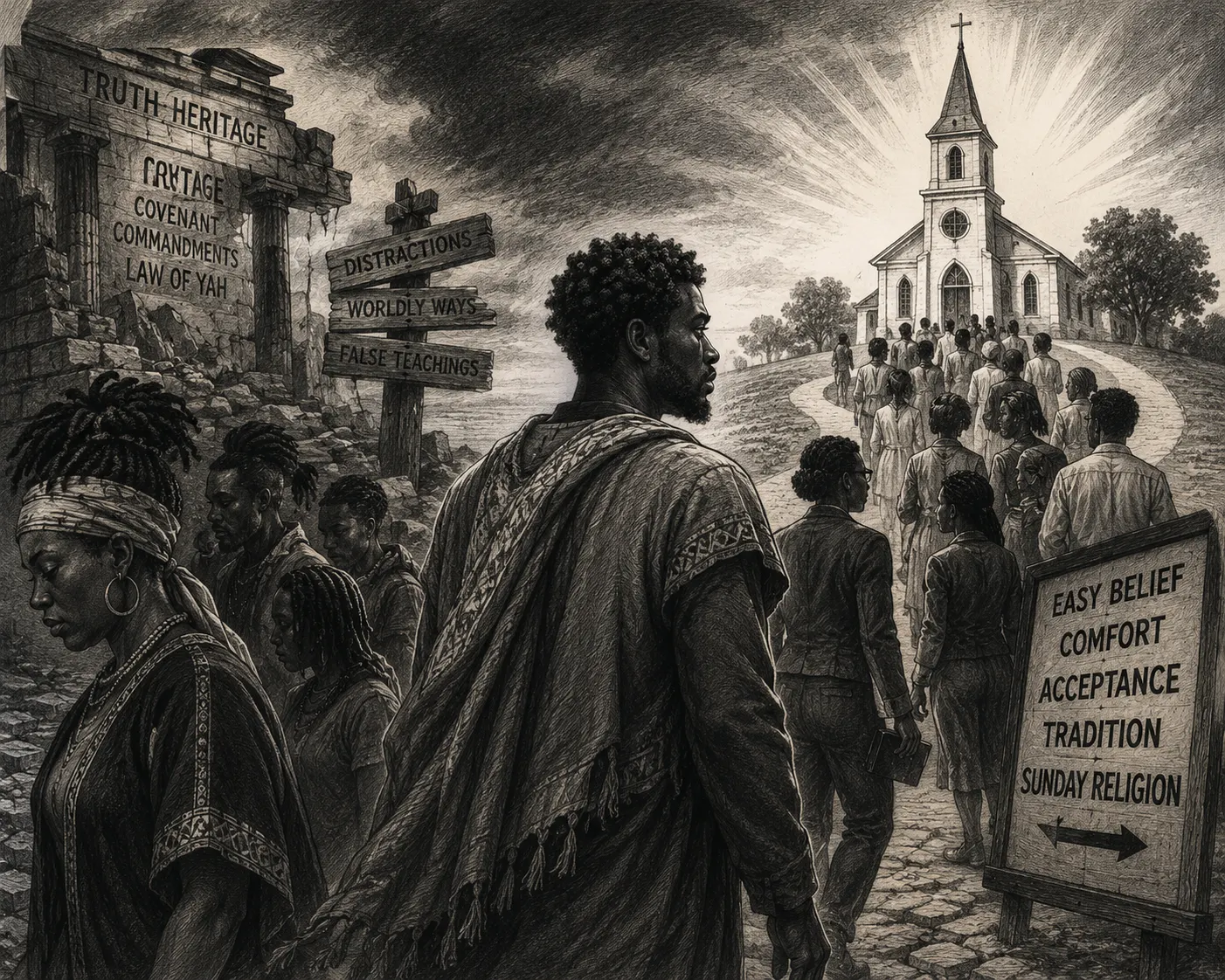
Sometimes it is comfort.
Sometimes it is acceptance.
Sometimes it is fear.
Sometimes it is ambition.
Sometimes it is disappointment.
Sometimes it is simply the desire to live an easier life.
Whatever form it takes, the challenge remains the same.
Will truth continue occupying the highest place in the heart when holding onto it becomes costly?
This question becomes especially relevant when we consider the times in which we are living. The modern world offers countless distractions. Never before have people had access to so much information while simultaneously facing so many opportunities to become distracted from what truly matters.
Attention is constantly being pulled in different directions.
Convictions are constantly being challenged.
Comfort is constantly being marketed.
Compromise is constantly being normalized.
Under such conditions, faithfulness requires more than intellectual agreement.
It requires intentional devotion.
The believer who remains faithful in the last days will not necessarily be the one who possesses the most information. Rather, it may be the one who continually returns their heart to YAH.
The one who continually chooses obedience over convenience.
The one who continually chooses conviction over comfort.
The one who continually chooses faithfulness over acceptance.
These choices are rarely dramatic.
Most of the time they occur quietly.
No audience is watching.
No applause follows.
No recognition is given.
Yet these ordinary decisions slowly shape the direction of an entire life. This is one reason Scripture repeatedly emphasizes daily faithfulness rather than occasional heroics. Many Israelites imagine that spiritual success is determined by a few extraordinary moments. The Bible often presents a different picture. The life of faith is built through thousands of ordinary decisions.
A prayer offered when no one notices.
A temptation resisted when compromise would be easier.
A commandment honored when no one else seems to care.
A Sabbath kept when it would be more convenient to ignore it.
These moments may appear insignificant individually.
Collectively, they reveal what a person truly values. Over time, they reveal what a person truly loves. And perhaps that brings us to the most important lesson contained within the warning about the falling away.
The goal is not merely to discover the truth.
Many people discover the truth.
The goal is not merely to understand the truth.
Many people understand the truth.
The goal is not merely to defend the truth.
Many people defend the truth.
The goal is to LOVE the Truth.
Because people fight for what they love. People sacrifice for what they love. People endure hardship for what they love. People remain loyal to what they love.
When truth becomes precious to a person, endurance becomes possible in ways that information alone can never produce.
This does not mean the journey becomes easy. It does not mean disappointments disappear. It does not mean loneliness vanishes. It does not mean temptations cease. It means that there is now something more valuable than the relief that compromise appears to offer.
There is now something more valuable than the acceptance that the world promises. There is now something more valuable than the comfort that comes from blending in.
There is truth.
And truth has become precious.
Perhaps this is why the Apostle Paul wrote:
2 Thessalonians 2:10 (KJV)
“And with all deceivableness of unrighteousness in them that perish; because they received not the love of the truth, that they might be saved.”
Notice the phrase carefully.
Paul does not merely say they failed to receive the truth. He says they failed to receive the love of the truth.
That distinction is profound. The issue is not merely possession of truth. The issue is affection for truth.
The issue is whether truth has become something cherished rather than simply acknowledged. This verse may provide one of the clearest explanations for why some remain faithful while others fall away.
Both may encounter truth.
Both may understand truth.
Both may recognize truth.
But not everyone develops a love for it.
And when trials come, it is often love that determines what remains.
The warning about the falling away is therefore not merely a prophecy concerning others.
It is a call for self-examination.
It invites every Israelite to ask difficult questions.
What do I treasure most?
What occupies the center of my life?
What am I unwilling to lose?
If the cost of obedience increases, will my devotion remain unchanged?
If disappointment comes, will my trust remain anchored in YAH?
If loneliness comes, will my convictions remain intact?
If the world offers comfort in exchange for compromise, what choice will I make?
These are not questions that can be answered once and forgotten. They must be revisited throughout the journey. Because faithfulness is not a single decision. Faithfulness is a lifelong pursuit.
And the longer one walks this path, the clearer it becomes that the greatest challenge is not discovering the truth.
The greatest challenge is continuing to love it.
This is why the Messiah’s words remain as powerful today as when they were first spoken:
Matthew 24:13 (KJV)
“But he that shall endure unto the end, the same shall be saved.”
The Messiah did not praise those who merely began. He praised those who endured. Not because beginnings are unimportant.
But because endurance reveals what was truly in the heart all along.
And in the last days, that may be the difference between those who simply saw the truth and those who loved it enough to remain faithful until the end.
(See our book, The Chosen Seed: Predestination)
Shalom,
Keep in Touch
Explore the full Unknown Hebrew Collection for more scripture-based studies.
Stay updated with teachings — follow Unknown Hebrew on Substack.
Have questions? Contact Unknown Hebrew directly.