
Living Through a Historic Shift
Every generation experiences technological change, but there are rare moments in history when humanity crosses a threshold that permanently alters civilization. The invention of the printing press changed how information moved through society. The Industrial Revolution changed how people worked. The internet changed how people communicated.
Artificial intelligence may prove to be another one of those moments.
Whether a person embraces AI enthusiastically or views it with suspicion, few would deny that something significant is happening. Technologies that seemed impossible only a decade ago are now available to ordinary people. Computers can generate essays, create artwork, mimic human voices, write software, translate languages, and answer complex questions within seconds.
For many people, these developments are exciting. Businesses see opportunity. Researchers see innovation. Governments see strategic advantages. Consumers see convenience.
Yet believers should be asking a different question.
The most important question is not what artificial intelligence can do.
The most important question is what artificial intelligence may do to humanity’s ability to recognize truth.
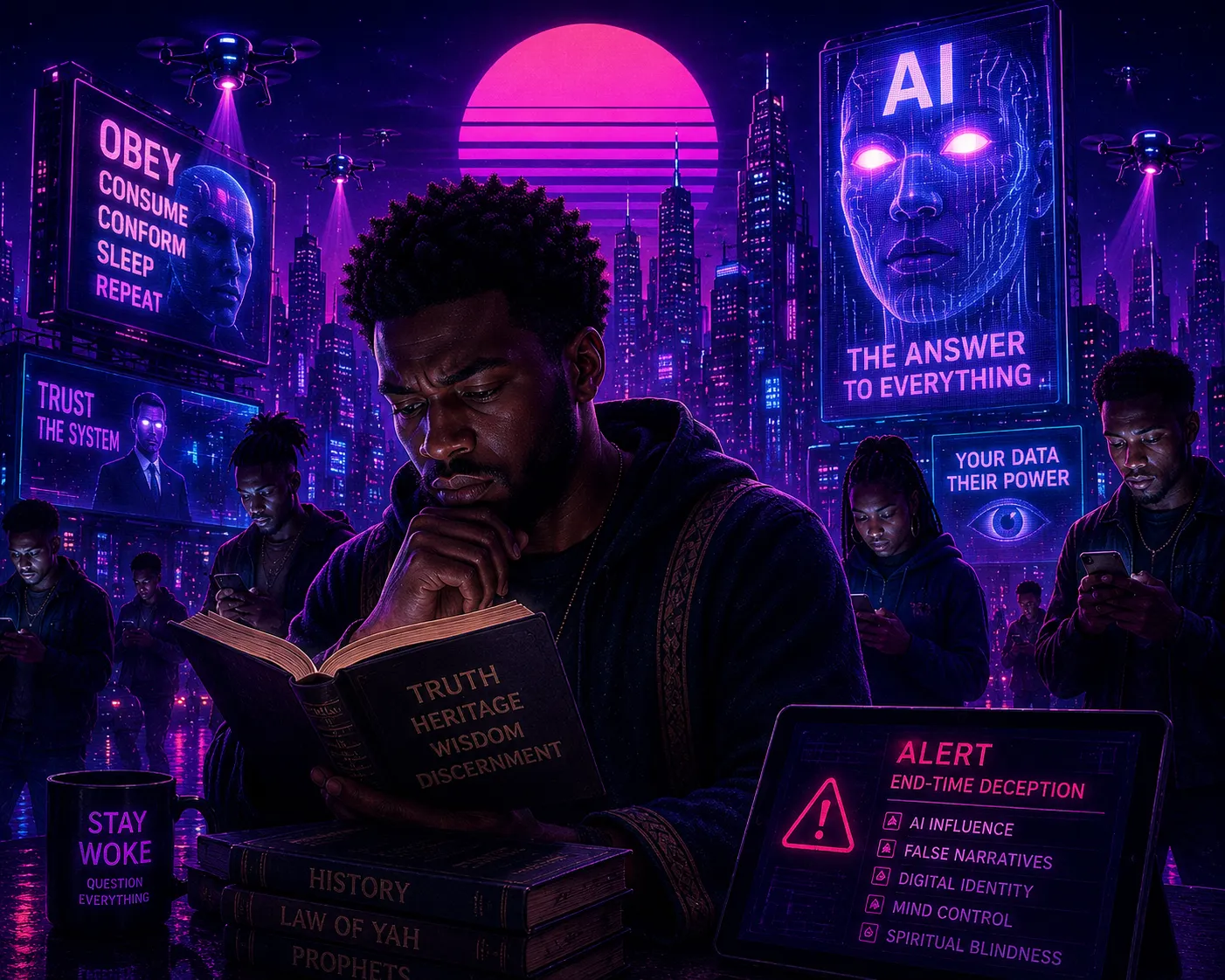
Because if there is one theme that runs consistently throughout biblical prophecy concerning the last days, it is deception.
Not war.
Not famine.
Not economic collapse.
Deception.
Again and again, the Scriptures warn that the final generations of humanity will face unprecedented confusion regarding what is true and what is false. For Israelites seeking to remain faithful to YAH, this raises an important possibility.
Could artificial intelligence become one of the greatest tools for deception ever created?
And if so, how should believers prepare themselves?
(See our book, The Path: Of Righteousness)
The Last Days Are Defined By Deception
One of the most striking aspects of end-time prophecy is how frequently the Messiah warned about deception.
When the disciples asked about the signs of His coming and the end of the age, His first response was not about warfare or politics.
His first warning concerned deception.
Matthew 24:4-5 (KJV)
“And YAHUSHUA answered and said unto them, Take heed that no man deceive you. For many shall come in my name, saying, I am Christ; and shall deceive many.”
This is significant.
Before discussing tribulation, persecution, or world events, the Messiah emphasized the danger of being deceived.
Why?
Because deception is uniquely dangerous.
A person who knows they are being attacked can defend themselves. A person who knows they are being lied to can reject the lie.
The deceived person believes they possess the truth while actually embracing error. That is what makes deception so powerful. The challenge becomes even greater when technology enables lies to appear increasingly convincing.
For most of human history, evidence was relatively simple to evaluate.
A photograph was considered evidence.
A recorded voice was considered evidence.
A video was considered evidence.
Today, artificial intelligence is rapidly changing those assumptions.
Voices can be cloned.
Images can be generated.
Videos can be fabricated.
Entire conversations can be simulated.
The result is a world where seeing is no longer believing. And that reality should cause believers to pay attention. Remember the meaning of Ha’Satan is deceiver, so in the days ahead we are moving in a world where he will dominate the minds of many people, both Israelites and non-Israelites alike. But at the same time Ha’Satan increases his power, YAHUAH is increasing his within this world as well.
(See our book, The Chosen Seed: Predestination)
The Danger Is Not AI Itself
Whenever new technology emerges, people often divide into two extreme camps. One group views the technology as entirely good. The other views it as entirely evil.
The biblical perspective is usually more balanced. Technology itself is generally neutral. Its moral value depends upon how it is used. The internet can spread Scripture or pornography. Printing presses can publish Bibles or propaganda. Television can educate or corrupt.
The same principle applies to artificial intelligence.
AI can help translate ancient manuscripts.
AI can assist medical research.
AI can improve productivity.
AI can help people learn new skills.
Yet the same technology can also be used to manipulate, deceive, and control.
The danger is not found within the tool itself. The danger is found within the human heart that controls the tool. This is why discussions about AI should never focus exclusively on machines.
The real issue remains human nature.
Scripture consistently teaches that mankind possesses an extraordinary capacity for corruption. Technology merely amplifies that capacity. A dishonest person with powerful tools becomes capable of greater deception than a dishonest person without them.
And this is where AI becomes particularly relevant to end-time prophecy.
The concern is not whether machines become evil.
The concern is whether evil people gain unprecedented abilities to influence perception, manufacture narratives, and manipulate reality. An example of this is people like Joe Rogan and Peter Thiel who are trying to advocate for an AI “Jesus” and that “God” can be AI. These ideas are not new, but it does explain how people with little to no understanding of the scriptures can deceive the masses into believing that the tool of AI itself can be used to create a “god.”
(See our book, Knowing the Father and the Son: Those who seek the truth will find it)
Knowledge Is Increasing, But Wisdom Is Not
One of the most fascinating prophecies in Scripture appears in the book of Daniel.
Daniel 12:4 (KJV)
“But thou, O Daniel, shut up the words, and seal the book, even to the time of the end: many shall run to and fro, and knowledge shall be increased.”
Many believers view this verse as describing the modern world. Never before has humanity possessed access to so much information. Billions of pages of content exist online. Entire libraries fit inside a smartphone.
Artificial intelligence can summarize vast amounts of information within seconds. Knowledge is certainly increasing. But there is an important distinction between knowledge and wisdom.
Knowledge answers questions.
Wisdom asks whether those questions should be asked.
Knowledge provides information.
Wisdom provides discernment.
Knowledge tells a person what can be done.
Wisdom helps determine what should be done.
Modern society has become extraordinarily knowledgeable while often becoming increasingly unwise. Artificial intelligence accelerates this trend. It can produce information faster than any previous generation. But it cannot automatically produce wisdom.
And that creates a serious problem.
Because wisdom is precisely what believers need most in an age of deception. And wisdom is only found in the scriptures of YAHUAH.
(See our book, Has the Law been done away with?)
When Seeing Is No Longer Believing
For most of human history, people relied heavily upon their senses to determine what was real. If something could be seen with the eyes, heard with the ears, or witnessed by multiple people, it was generally considered trustworthy. While deception certainly existed, fabricating reality on a large scale was difficult. Lies required effort. Falsehoods were limited by the tools available to those creating them.
Artificial intelligence is changing that equation.
What makes this technological moment unique is not merely the speed at which information can be created. It is the increasing ability to manufacture experiences that appear authentic even when they are entirely false.
A photograph can be generated of an event that never occurred.
A recording can be created of a person saying words they never spoke.
A video can be produced showing actions that never happened.
As these technologies improve, the line between authentic and artificial becomes increasingly difficult to identify.
The implications extend far beyond politics or entertainment.
They strike at one of the foundations upon which societies function: trust.
Trust is one of those things that people rarely think about until it begins disappearing. Every day, individuals make countless decisions based upon assumptions of authenticity. They assume photographs represent reality. They assume recordings are genuine. They assume public statements came from the people attributed to them.
When those assumptions become unreliable, confusion follows.
And confusion creates fertile ground for deception.
This is one reason the rise of artificial intelligence feels different than many previous technological advancements. The issue is not merely that more information is being created. The issue is that reality itself is becoming increasingly difficult to verify.
The result is a world where people may become suspicious of everything.
Ironically, this creates two opposite dangers.
Some people will become too trusting.
Others will become incapable of trusting anything at all.
Both conditions are dangerous.
The first leaves a person vulnerable to deception. The second leaves a person vulnerable to cynicism. Neither represents genuine discernment. Discernment occupies a different place entirely. Discernment is not gullibility. Neither is it suspicion. Discernment is the ability to distinguish between truth and falsehood when both appear convincing.
And that ability is becoming increasingly valuable.
Perhaps this helps explain why Scripture consistently emphasizes spiritual discernment rather than merely intellectual knowledge. The challenge facing Israelites has never simply been a lack of information. The challenge has always been recognizing truth amid competing voices.
Artificial intelligence is not creating that challenge.
It is amplifying it.
(See our book, The Order Of Melchizedek: According To The 12 Patriarchs)
Why Discernment Will Become More Valuable Than Information
There was a time when obtaining information was difficult. Today, the opposite problem exists. People are drowning in information. Every day brings new articles, videos, podcasts, social media posts, studies, opinions, and analyses. The average person encounters more information in a single day than many people in previous centuries encountered in months.
Artificial intelligence is accelerating this trend dramatically.
Information can now be generated at extraordinary speed. Entire articles can be written in moments. Thousands of images can be created in hours. Content that once required large teams can now be produced by a single individual equipped with powerful tools.
This creates an interesting paradox.
As information becomes more abundant, its value decreases. What becomes valuable instead is the ability to evaluate information correctly. In other words, discernment becomes more important than knowledge. This principle is deeply biblical.
The Scriptures never portray wisdom as the simple accumulation of facts. Wisdom involves correctly applying truth. Discernment involves recognizing what is trustworthy and what is not.
The book of Proverbs repeatedly emphasizes this distinction. A wise person is not merely informed. A wise person is discerning. This is one reason the fear of YAH occupies such a central place within biblical wisdom.
Proverbs 9:10 (KJV)
“The fear of the YAHUAH is the beginning of wisdom: and the knowledge of the holy is understanding.”
Notice the order.
Wisdom begins with reverence toward YAH.
Not technology.
Not education.
Not information.
YAH.
This becomes increasingly important in a world overflowing with competing voices. Many people assume that access to more information automatically produces better decisions. Yet history repeatedly demonstrates otherwise. Human beings often possess tremendous amounts of information while making disastrous choices.
The problem is not ignorance.
The problem is interpretation.
The problem is discernment.
Artificial intelligence may provide answers to countless questions. It cannot replace the wisdom necessary to evaluate those answers correctly. And that distinction may become one of the defining spiritual challenges of the coming decades.
(See our book, Song of Solomon: A Complete Breakdown)
The Rise of Counterfeit Authority
Another consequence of artificial intelligence is the growing difficulty of determining who or what deserves authority.
Throughout history, authority was often connected to expertise, experience, and demonstrated knowledge. While those standards were never perfect, they provided some measure of stability. People generally knew who possessed knowledge in a particular field and who did not.
Artificial intelligence is complicating that landscape.
A machine can now generate answers that appear highly intelligent.
It can summarize books.
It can explain concepts.
It can produce persuasive arguments.
It can imitate expertise.
For many people, this creates a temptation to treat technology as an authority rather than as a tool. This temptation extends beyond AI itself. Human beings have always been attracted to sources of certainty.
People naturally seek voices that appear confident, knowledgeable, and authoritative. The danger arises when confidence becomes confused with truth. Scripture repeatedly warns about this tendency.
False prophets rarely present themselves as false prophets.
Deceivers rarely announce themselves as deceivers.
The most effective counterfeit resembles the genuine article closely enough to gain trust.
This is why the Messiah warned repeatedly about false teachers. The danger was not that they would appear obviously false. The danger was that they would appear convincing.
Matthew 24:24 (KJV)
“For there shall arise false Christs, and false prophets, and shall shew great signs and wonders; insomuch that, if it were possible, they shall deceive the very elect.”
This verse should cause Israelites to think carefully about the nature of deception.
The Messiah does not describe weak deception. He describes powerful deception. Deception capable of misleading even sincere followers of YAH.
The relevance to modern technology should be obvious. As tools become more sophisticated, appearances become increasingly unreliable. Authority can be manufactured. Credibility can be simulated. Expertise can be imitated.
The challenge facing believers is therefore not simply acquiring information.
The challenge is evaluating sources wisely.
It is learning to distinguish genuine authority from artificial authority. And that requires something deeper than technology can provide. It requires spiritual discernment.
(See our book, The Path: Of Righteousness)
The Temptation to Replace Dependence Upon YAH
Perhaps the greatest spiritual danger associated with artificial intelligence has nothing to do with deception at all.
It concerns dependence.
Throughout biblical history, one of humanity’s recurring struggles has been the temptation to place trust in created things rather than in the Creator.
The specific objects change. The temptation remains the same. Some generations trusted military power. Others trusted wealth. Others trusted political systems. Others trusted idols made with human hands.
Modern society increasingly places its trust in technology.
Technology promises efficiency.
Technology promises convenience.
Technology promises solutions.
Technology promises control.
None of these things are inherently wrong.
The danger appears when trust begins shifting away from YAH and toward human capability.
Artificial intelligence may intensify this temptation because it creates the impression that answers are always available.
Need information?
Ask the machine.
Need guidance?
Ask the machine.
Need analysis?
Ask the machine.
Need solutions?
Ask the machine.
Gradually, a subtle shift can occur.
The habit of seeking answers begins replacing the habit of seeking YAH. The technology itself is not responsible for this shift.
Human nature is.
Yet the result remains spiritually dangerous. Because prayer, meditation upon Scripture, and dependence upon YAH were never intended to be replaced by convenience. The Israelites were repeatedly reminded that their security came from YAH rather than from human strength.
That lesson remains relevant today. Technology may be useful. Technology may be beneficial. Technology may even become necessary in many aspects of life.
But technology remains a tool.
It was never meant to become a substitute for wisdom, discernment, or communion with YAH.
And Israelites who forget that distinction may find themselves spiritually weaker despite becoming technologically stronger.
(See our book, Knowing the Father and the Son: Those who seek the truth will find it)
Why Israelites Must Remain Rooted in Scripture
If there is one lesson that emerges from every discussion about deception, technology, false teachings, and the challenges of the last days, it is that Israelites need an anchor.
The world is changing too quickly for anything less.
Every generation experiences change, but the pace of change today is unlike anything most of human history has witnessed. New technologies emerge almost monthly. Entire industries are transformed in a matter of years. Communication methods evolve constantly. Information spreads globally within seconds.
In such an environment, it becomes increasingly difficult to distinguish between what is temporary and what is permanent.
This is where Scripture occupies a unique place.
Everything around us is changing.
The Word of YAH is not.
Governments change. Cultures change. Technologies change. Economic systems change. Human opinions change.
The Scriptures remain.
This is one reason believers throughout history have repeatedly returned to the Word during periods of uncertainty. The Scriptures provide something that the world cannot provide: stability.
Artificial intelligence may become more powerful. Political systems may become more unstable. Media environments may become more confusing. The need for a fixed standard will only increase.
For Israelites, that standard cannot be popular opinion.
It cannot be technological consensus.
It cannot be social trends.
It cannot be whatever appears convincing at a particular moment.
It must be the Word of YAH.
This principle becomes especially important when considering the nature of end-time deception. The Scriptures do not merely warn that deception will exist. They warn that deception will become increasingly persuasive.
This means Israelites cannot rely solely upon appearances. They cannot rely solely upon emotions. They cannot rely solely upon what seems convincing. They need something deeper.
Something fixed.
Something that exists outside the constant fluctuations of society.
The Psalmist expressed this beautifully:
Psalm 119:89 (KJV)
“For ever, O’ ELOHIM, thy word is settled in heaven.”
There is something profoundly comforting about this verse.
While everything around us appears unstable, the Word remains settled.
While opinions shift, the Word remains settled.
While technologies evolve, the Word remains settled.
While human understanding changes, the Word remains settled.
This permanence is one of the greatest gifts YAH has given His people.
It provides a reference point by which everything else can be evaluated. Without such a reference point, discernment becomes nearly impossible. A person who lacks a fixed standard will eventually find themselves carried wherever the strongest current happens to flow.
This is one reason deception becomes increasingly dangerous in an age of information overload. The problem is not merely that falsehood exists.
Falsehood has always existed.
The problem is that competing claims now arrive faster than most people can evaluate them. One day a narrative appears. The next day it is challenged. The following day a new narrative emerges. The cycle repeats endlessly.
People become overwhelmed.
Exhausted.
Confused.
And in that confusion, many simply begin following whichever voice appears most confident. Scripture offers a different approach. Instead of chasing every new claim, Israelites are called to test everything against the Word.
The Apostle Paul wrote:
1 Thessalonians 5:21 (KJV)
“Prove all things; hold fast that which is good.”
Notice the balance. Paul does not encourage blind acceptance. Neither does he encourage blind skepticism. He encourages examination.
Testing.
Evaluation.
Discernment.
This mindset becomes increasingly valuable in an age where information can be manufactured instantly.
The Israelite who remains rooted in Scripture possesses something many others lack.
A measuring rod. A standard. A foundation.
Such an Israelite is not immune to deception. No human being is. Yet they possess a framework through which claims can be evaluated. That framework becomes more important with each passing year. Perhaps this is why the Scriptures repeatedly emphasize meditation upon the Word.
Meditation is not merely reading.
It is dwelling upon truth. Reflecting upon it. Allowing it to shape how one thinks and perceives reality.
The Psalmist wrote:
Psalm 1:2-3 (KJV)
“But his delight is in the law of the ELOHIM; and in his law doth he meditate day and night. And he shall be like a tree planted by the rivers of water, that bringeth forth his fruit in his season…”
The imagery is striking. A tree planted by rivers remains stable because its roots reach something deeper than surface conditions.
Storms come.
Seasons change.
Droughts occur.
Yet the tree remains because its source of nourishment is not dependent upon temporary circumstances. The same principle applies spiritually. The Israelite rooted in Scripture may witness tremendous cultural upheaval. They may observe technological revolutions. They may encounter confusion and deception.
Yet they remain grounded because their roots extend into something deeper than the changing world around them.
And that may be one of the greatest challenges facing Israelites in the age of artificial intelligence.
Not learning how to use technology. Not learning how to avoid technology.
Learning how to remain rooted while living alongside technology. Learning how to benefit from useful tools without allowing those tools to become masters. Learning how to embrace innovation without sacrificing discernment. Learning how to navigate an increasingly artificial world while remaining devoted to eternal truth.
This balance will require wisdom.
It will require discipline.
Most of all, it will require Israelites to remember that no technological advancement can replace the role that Scripture was intended to play in their lives. The Word is not merely one source of information among many. It is the foundation upon which everything else must be evaluated.
And that truth becomes increasingly important as the world moves deeper into an age where appearances can be manufactured, authority can be simulated, and reality itself becomes more difficult to verify.
(See our book, Has the Law been done away with?)
The Battle for Truth in an Artificial Age
Every generation faces unique challenges. The Israelites who left Egypt faced challenges unlike those faced by the prophets. The prophets faced challenges unlike those faced by the apostles. The apostles faced challenges unlike those faced by Israelites living today.
Yet despite these differences, a common thread runs through every generation of faithful people.
They were required to choose whom they would trust.
Would they trust the voice of YAH?
Or would they trust the countless competing voices surrounding them?
That question remains just as relevant today as it was thousands of years ago.
Artificial intelligence has introduced remarkable possibilities. It has the potential to accelerate research, improve communication, increase productivity, and solve problems that once seemed impossible.
These developments should not be ignored. Neither should they be feared irrationally. Yet neither should they be embraced uncritically. The rise of artificial intelligence represents more than a technological event.
It represents a spiritual challenge.
Not because machines have become spiritual beings. Not because algorithms possess supernatural power. But because technology is reshaping the environment in which truth and deception compete for attention.
As information becomes easier to generate, discernment becomes more valuable. As appearances become easier to manipulate, wisdom becomes more valuable. As authority becomes easier to imitate, spiritual maturity becomes more valuable.
The battle facing Israelites in the years ahead may not be a battle over access to information. It may be a battle over the ability to recognize truth amid overwhelming amounts of information.
And that battle cannot be won through technology alone. It requires something deeper.
It requires wisdom.
It requires discernment.
It requires a heart trained by Scripture.
It requires a relationship with YAH that extends beyond intellectual knowledge.
Perhaps this is why the Messiah’s warnings about deception feel increasingly relevant. The issue has never been whether deception exists. The issue has always been whether believers are prepared to recognize it. And preparation begins long before deception appears.
It begins with daily faithfulness. It begins with prayer. It begins with studying the Word. It begins with cultivating discernment. It begins with learning to love truth more than convenience, comfort, or novelty.
Because in the end, technology will continue evolving. Artificial intelligence will continue advancing. The world will continue changing. But the fundamental challenge facing believers will remain the same.
Will we remain anchored to the truth when countless alternatives compete for our attention?
Will we remain faithful when certainty becomes difficult to find?
Will we continue trusting the Word when the world offers increasingly sophisticated substitutes?
These questions may define the spiritual landscape of the coming generation. And the Israelites who navigate that landscape successfully will likely be those who remember a simple but powerful truth:
Technology may change the world.
But only the Word of YAH can safely guide us through it.
Psalm 119:105 (KJV)
“Thy word is a lamp unto my feet, and a light unto my path.”
In an age of artificial intelligence, that light may be needed more than ever.
(See our book, The Chosen Seed: Predestination)
Shalom,
Keep In Touch
Explore the full Unknown Hebrew Collection for more scripture-based studies.
Stay updated with teachings — follow Unknown Hebrew on Substack.
Have questions? Contact Unknown Hebrew directly.