
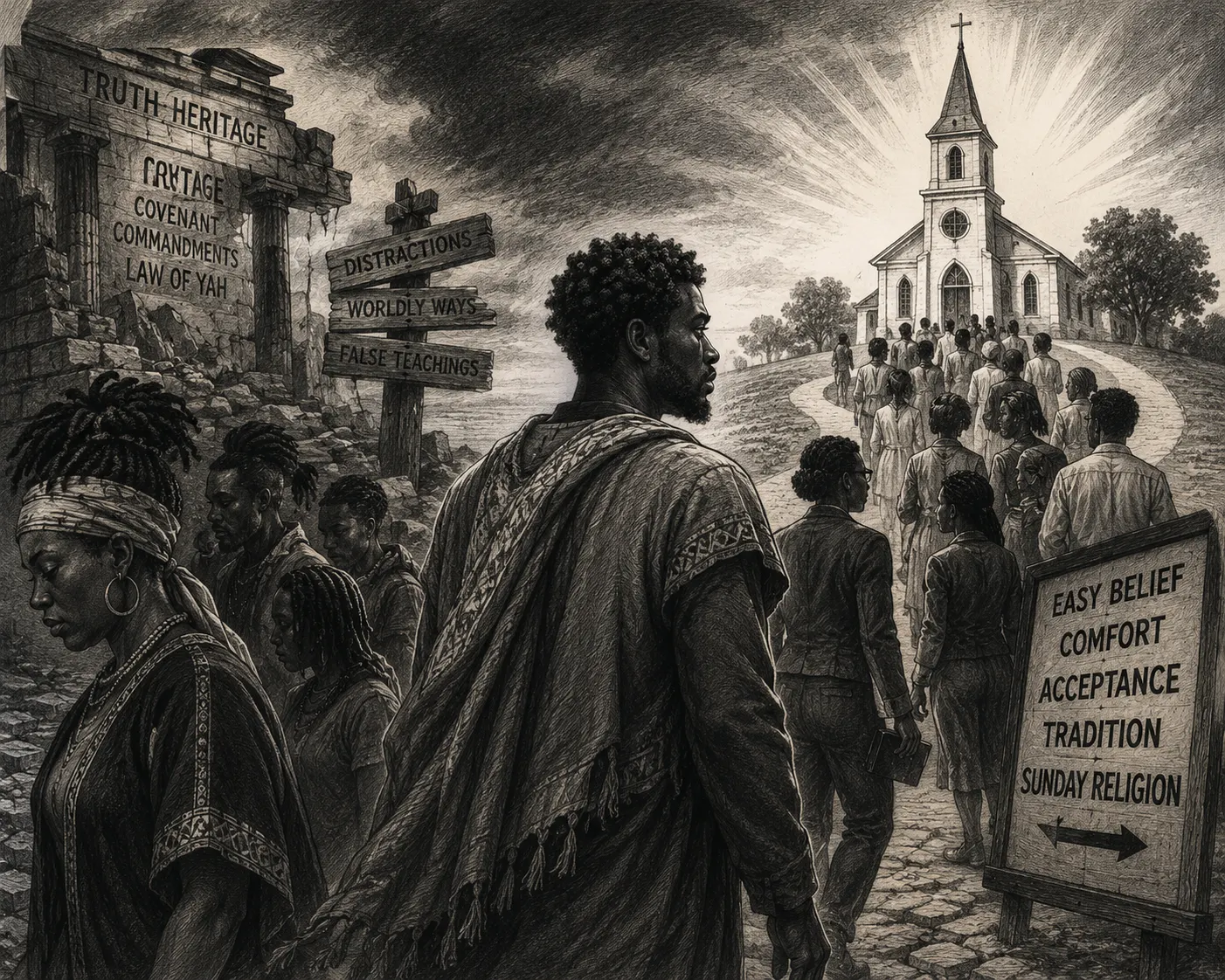
A Trend That Should Concern Every Israelite One of the most unsettling trends many believers have noticed in recent years is the growing number of Israelites who are returning to Christianity after once embracing what they believed was biblical truth. Some were Sabbath keepers. Some observed the feast days. Some taught the dietary laws. Some openly defended Torah and challenged mainstream church doctrine. Yet today many of those same individuals have gone back to the churches they once left, the traditions they once questioned, and the doctrines they once rejected. For those who remain committed to the commandments, this trend raises difficult questions. How can someone spend years studying Scripture and then walk away from what they once believed was truth? How can a person who once defended the Sabbath later argue against it? How can someone who once taught obedience suddenly begin teaching that obedience is unnecessary? The easy answer is to simply accuse such people of deception, weakness, or rebellion. Certainly, in some cases those accusations may be justified. However, if we stop there, we miss an opportunity to learn something important. The reality is that every warning in Scripture exists for a reason. When we witness others falling away, we should not only ask why they left. We should also ask what their departure reveals about the spiritual challenges facing all believers in these last days. The truth is that discovering truth and remaining faithful to truth are two very different things. Many people assume that once someone learns the truth, the battle is over. Scripture teaches the opposite. Learning the truth often marks the beginning of the battle rather than the end of it. The moment a person begins walking a different path from the world around them, new pressures emerge. New temptations appear. New forms of opposition arise. The Israelite who once thought the greatest challenge was finding the truth soon discovers that the greater challenge is remaining faithful to it. This is one reason the Scriptures place such a strong emphasis on endurance. The Bible rarely praises people simply for beginning well. Instead, it repeatedly focuses on those who remained faithful when obedience became difficult. And has reverence for the people who kept their obedience to YAHUAH to their dying breath. (See our books, The Path: Of Righteousness) The Bible Never Promised That Everyone Who Finds Truth Would Stay With It One assumption many believers make is that once someone sees the truth clearly, they will never abandon it. On the surface this seems reasonable. If something is true, why would anyone knowingly walk away from it? Yet the Bible repeatedly shows that knowledge alone does not guarantee faithfulness. Ancient Israel witnessed miracles in Egypt, saw the Red Sea divided, ate manna from heaven, and heard the voice of YAH at Sinai. Yet despite experiencing things most people can scarcely imagine, many still rebelled. Their problem was not lack of evidence. Their problem was that knowledge and obedience are not the same thing. The same principle appears throughout Scripture. Judas walked with the Messiah and heard His teachings firsthand, yet still betrayed Him. Demas labored alongside Paul, yet eventually abandoned the work. Entire generations of Israelites witnessed the power of YAH and still turned aside. The lesson is sobering. A person can be exposed to the truth without allowing it to fully transform their heart. The Apostle Paul warned believers that a great departure from truth would occur before the end. 2 Thessalonians 2:3 (KJV) “Let no man deceive you by any means: for that day shall not come, except there come a falling away first…” This warning is significant because Paul is not describing people who never knew anything about Scripture. He is describing people who were once connected to truth and later departed from it. That reality should humble every believer. Sometimes people discuss the falling away as though it only applies to others. They imagine it happening somewhere outside of their own circles. Yet Paul’s warning is valuable precisely because it reminds us that no one should become spiritually complacent. The Israelite who assumes they could never be deceived often becomes vulnerable to deception because they stop guarding their heart carefully. The Scriptures never teach believers to place confidence in themselves. Instead, they continually call us to vigilance, humility, prayer, and dependence upon YAH. (See our book, Peace Be Still John 14:27: Peace For Everyday Living, His Shalom) What Happens When the Excitement of Discovering Truth Begins to Fade? What often surprises believers is that the greatest threat to their faith rarely arrives when they are weak. More often it arrives when they feel strongest. When most people first discover what they believe to be biblical truth, there is an almost overwhelming sense of certainty. Scriptures that once seemed confusing suddenly appear obvious. Questions that lingered for years seem to answer themselves. Entire sections of the Bible begin fitting together in ways they never had before. It is difficult to describe that experience to someone who has never gone through it. For many Israelites, it feels less like learning something new and more like waking up. In those moments it is easy to imagine that the journey ahead will be relatively straightforward. After all, once a person sees the truth, why would they ever want to leave it? The answer seems self-evident. If something is true, then surely the natural response is to hold onto it. Yet experience shows that reality is rarely that simple. The difficulty is that spiritual life cannot survive forever on discovery. Discovery is powerful, but it is temporary by nature. Eventually every revelation becomes familiar. Every doctrine becomes something you have heard before. Even the most profound truths eventually become part of ordinary life. This is where many believers encounter a challenge they never anticipated. The excitement that once carried them forward begins to settle, and for the first time they find themselves walking by conviction rather than enthusiasm. At first the