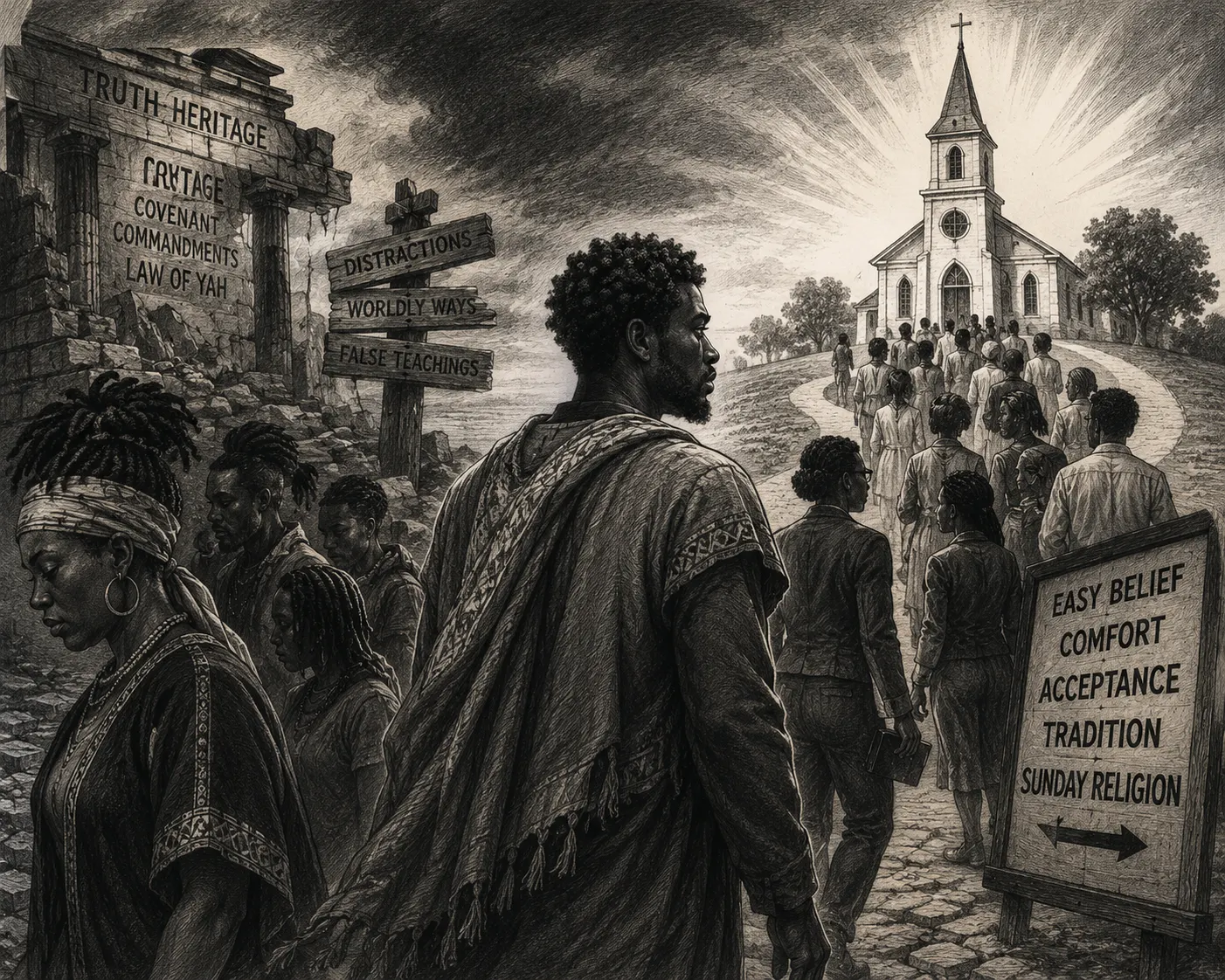


Why This Question Is So Important
Few doctrines have caused more confusion, division, and deception than the belief that the Law of YAH has been done away with. This idea is taught across mainstream Christianity as a foundational truth. Many are told that under the New Covenant, the commandments no longer apply, that grace has replaced obedience, and that attempting to keep the law is either unnecessary or even wrong.
But when we examine the Scriptures carefully, we find that this teaching does not align with the Word. It creates contradictions. It redefines obedience. It separates faith from action. And most importantly, it challenges the very words of the Messiah Himself.
This is not a small issue. This is not a minor doctrinal disagreement. This is a question that directly affects how a person lives, worships, and relates to YAH.
If the law has truly been done away with, then:
There is no need for commandments
sin becomes undefined
Obedience becomes optional
But if the law still stands, then:
Obedience still matters
sin still exists
accountability remains
So the question must be answered clearly—not based on tradition, not based on what churches teach, but based on Scripture.
(See our book, Has the Law been done away with?)
What Did the Messiah Say About the Law?
Before we go anywhere else, we must start with the words of the Messiah. If there is any confusion about the law, His words must settle it.
Matthew 5:17-18 (KJV)
“Think not that I am come to destroy the law, or the prophets: I am not come to destroy, but to fulfil. For verily I say unto you, Till heaven and earth pass, one jot or one tittle shall in no wise pass from the law…”
This statement is direct and unmistakable.
First, He says:
“Think not…”
That means He knew people would think this. He knew there would be a future belief that He came to destroy the law. So He corrected it before it could spread.
Then He says:
“I am not come to destroy…”
That removes all ambiguity.
Then He adds:
“Till heaven and earth pass…”
Look around. Heaven and earth are still here. That means the law has not passed.
If someone claims the law is done away with, they must answer this:
Has heaven and earth passed?
If the answer is no, then the law has not passed.
What Does “Fulfill” Actually Mean?
One of the most misunderstood words in this entire discussion is the word “fulfil.”
Many have been taught that “fulfil” means:
end
complete
remove
finish permanently
But that interpretation creates a contradiction. If “fulfil” means destroy, then the Messiah would be contradicting Himself in the same sentence.
“I am not come to destroy… but to destroy.”
That makes no sense.
The word “fulfil” means:
to bring to full expression
to establish
to carry out completely
The Messiah fulfilled the law by:
living it perfectly
teaching it correctly
showing its true meaning
He did not remove it—He revealed it.
This is why immediately after saying this, He begins expanding the law:
anger = murder in the heart
lust = adultery in the heart
He did not lower the standard. He raised it. He made it that if you think about doing an action then you are in breach of the spirit of the law. Under the original covenant ONLY the action was the breach of the law. This makes the New Covenant even harder to live by, not easier.
(See our book, The Path: Of Righteousness)
If the Law Is Gone, What Is Sin?
This is one of the most important logical questions in this discussion.
If the law has been done away with, then what defines sin?
1 John 3:4 (KJV)
“Whosoever committeth sin transgresseth also the law: for sin is the transgression of the law.”
This verse is clear:
Sin = breaking the law
So if the law is gone:
sin is gone
But we know sin is not gone.
People still:
lie
steal
commit adultery
murder
disobey
So if sin still exists, then the law must still exist. Because you cannot break something that no longer exists. The law is the pathway to the Kingdom, and only through the law and the righteousness of the Messiah’s sacrifice will we ever make it into the Kingdom of YAHUAH.
What Is the New Covenant Really?
This is where much of the confusion comes from.
People hear “New Covenant” and assume:
New means different laws
New means no laws
New means freedom from commandments
But Scripture defines the New Covenant clearly.
Jeremiah 31:33 (KJV)
“But this shall be the covenant… I will put my law in their inward parts, and write it in their hearts…”
This is the New Covenant.
Notice what it does NOT say:
It does not say “I will remove my law”
It does not say “I will replace my law”
It says:
“I will write my law in their hearts”
That means:
same law
new location
Before: written on stone
Now: written in the heart
So the New Covenant is not the removal of the law. It is the internalization of the law. It is the understanding that through the RUACH HA’ KODESH, there is a Renewal of the Mind, Body, and Spirit that compels one to live as YAHUSHUA lived. One who follows the Torah. One who takes all within the Torah into their inward parts so they are the expression of YAHUAH on this planet in human form. YAHUSHUA the son is the example of the, “renewal” or “new” covenant we have with His Father YAHUAH.
(See our book, What is the Gospel?)
Why Paul Is So Misunderstood
Much of the confusion about the law comes from misreading Paul.
Even Scripture warns about this.
2 Peter 3:16 (KJV)
“…in which are some things hard to be understood, which they that are unlearned… wrest…”
Peter warns that Paul’s writings can be twisted.
And that is exactly what has happened. We will review some of the main issues in the misunderstanding of Pauls writings.
“Not Under the Law but Under Grace”
Romans 6:14 (KJV)
“For ye are not under the law, but under grace.”
This is often used to say the law is gone.
But read the next verse:
Romans 6:15 (KJV)
“What then? shall we sin… YAHUAH forbid.”
Paul is saying:
You are not under the penalty of the law
But you still must not sin
And sin is breaking the law.
So Paul is not removing the law—he is explaining freedom from punishment, not freedom from obedience. And with a deeper understanding, you will find even back in the time of Adam and Eve, “grace” was given to them. In our book, The Symbiotic Relationship: Grace & Law, we go through every place where “grace” is used in the bible and prove that the Law of YAHUAH and Grace of YAHUAH are always linked. There is no Law without Grace, and there is no Grace without Law.
“The Law Is Done Away With”
People also misuse this:
Romans 3:31 (KJV)
“Do we then make void the law through faith? YAHUAH forbid: yea, we establish the law.”
Paul answers directly:
“YAHUAH forbid”
Faith does not remove the law.
It establishes it. Faith is the foundation of the Law and of the Grace that YAHUAH provides to us. Understanding this will deconstruct the lies being told by many within the Christian church. Many go as far as to say that if you try to keep the law, you are denying the Messiah’s sacrifice. Not understanding that His sacrifice was FOR you to keep the law. Not to become Lawless.
(See our book, What is the Gospel?)
The Real Problem: Lawlessness
The idea that the law is done away with leads to one thing:
Lawlessness
And the Messiah warned about this.
Matthew 7:23 (KJV)
“Depart from me… ye that work iniquity.”
“Iniquity” means lawlessness.
These people:
believed
prophesied
did works
But they were rejected because they did not keep the law. And worked within a Lawless paradigm that is an athama to the Messiah. The represented Ha’Shatan and his followers, not the followers of YAHUSHUA.
This is a serious matter.
Grace Does Not Replace Obedience
Another major misunderstanding is grace.
Grace is often taught as:
freedom to live however you want
But Scripture says:
Titus 2:11-12 (KJV)
“For the grace of YAHUAH…Teaching us that, denying ungodliness… we should live soberly, righteously…”
Grace teaches obedience.
Grace does not cancel righteousness.
Grace gives us time to repent, an opportunity to change, and mercy while we grow. Thus making it inseparable to the Law itself. Grace is the path TOWARDS righteousness, not against it. Grace is not permission to sin; it is a permission to better oneself to the ultimate goal of being a total expression of YAHUAH, just like our Messiah YAHUSHUA was.
Faith Without Works Is Dead
Some argue:
“We are saved by faith, not works.”
But they misunderstand the relationship.
James 2:17 (KJV)
“Faith, if it hath not works, is dead…”
Real faith produces obedience.
If someone claims faith but:
breaks commandments
ignores YAH’s laws
rejects obedience
Then their faith is dead. Their works are dead, and their doctrine leads them to Hell, not Heaven.
The Law Was Never the Problem
Many believe the law was flawed.
But Scripture says otherwise.
Romans 7:12 (KJV)
“Wherefore the law is holy, and the commandment holy, and just, and good.”
The law is:
holy
just
good
The problem was never the law.
The problem was:
Man’s inability to keep it perfectly
That is why we need mercy or “Grace.” But needing mercy does not mean removing the law. It is helping us conquer the flesh and live out the Torah within our everyday lives.
What This Means for Israelites Today
This truth changes everything.
If the law is still in effect:
We must keep the commandments
We must reject sin
We must live set-apart lives
This includes:
Sabbath
dietary laws
feast days
moral commandments
Not to earn salvation—but because we are called to obedience. Which was the whole reason for YAHUAH to kick us out of the Garden in the first place. He has given the way back into His Kingdom, but that way is only through His Commandments.
The Law Still Stands
The Scriptures are clear.
The Messiah did not destroy the law.
The New Covenant writes the law in the heart.
Sin is still defined by the law.
Faith establishes the law.
Grace teaches obedience.
The law has not been done away with.
The real question is not:
“Is the law still here?”
The real question is:
“Are you willing to obey it?”
Because in the end, YAH is not looking for those who argue about the law. He is looking for those who keep it.
(See our books, Has the Law been done away with? and The Symbiotic Relationship: Grace & Law for a more in-depth explanation)
Ecclesiastes 12:13 (KJV)
“Fear YAHUAH, and keep his commandments: for this is the whole duty of man.”
Shalom,
Keep In Touch
Explore the full Unknown Hebrew Collection for more scripture-based studies.
Stay updated with teachings — follow Unknown Hebrew on Substack.
Have questions? Contact Unknown Hebrew directly.