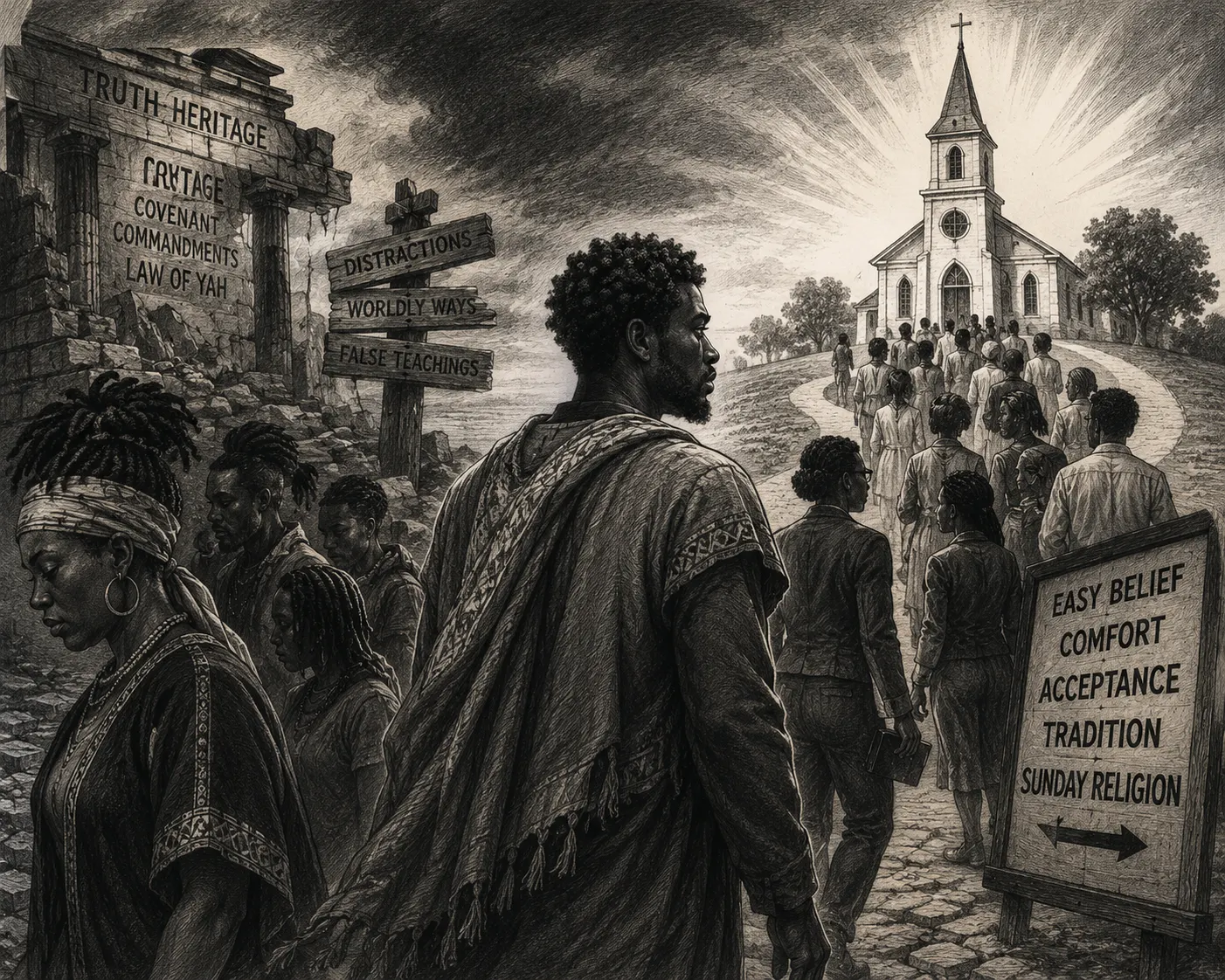


Why This Subject Matters So Much
Few teachings have affected modern Christianity more than the idea that grace and the law are enemies. Millions of people have been taught that once grace entered the picture, obedience became optional. They have been told that the commandments belonged to the “Old Testament,” while grace belongs to the “New Testament,” as though YAH changed His standards or no longer cared about righteousness.
Because of this teaching, many people sincerely believe:
-
the law is bondage
-
obedience is legalism
-
commandments are unnecessary
-
grace means freedom from responsibility
But when the Scriptures are examined carefully, this entire framework begins to collapse. The Bible never presents grace and the law as opposites. Instead, it presents them as working together.
The law defines righteousness. Grace provides mercy when righteousness has been violated. The law shows what sin is. Grace provides the opportunity to repent from that sin. Without the law, grace loses its meaning, because there would be no definition of wrongdoing in the first place. And vice versa, without grace, the law loses its meaning because we would immediately die of sin if there were no way back to the law without grace and repentance.
This is why the subject matters so deeply. If grace is misunderstood, then obedience disappears. And once obedience disappears, lawlessness takes its place.
(See our book, The Symbiotic Relationship: Grace & Law for a more in-depth explanation)
The Law Was Never the Problem
One of the first things that must be understood is that the Bible never describes the law itself as evil, corrupt, or unnecessary. In fact, Scripture consistently speaks about the law with honor and respect.
Romans 7:12 (KJV)
“Wherefore the law is holy, and the commandment holy, and just, and good.”
This verse alone destroys the idea that the law was some flawed system that needed to be removed. Paul describes the law using words that reflect the character of YAH Himself:
-
holy
-
just
-
good
Something that is holy does not become evil later. Something that is just does not suddenly become bondage. Something that is good does not suddenly become harmful.
The real issue was never the law. The problem was mankind’s inability to obey it perfectly. The law revealed righteousness, but people continued to sin. That is why grace became necessary—not because the law failed, but because people failed to uphold it.
This distinction is critical. Christianity often presents the law and grace as though they are competing systems. But Scripture presents grace as the answer to man’s weakness, not the destruction of YAH’s commandments.
(See our book, Song of Solomon: A Complete Breakdown)
What Grace Actually Is
One of the biggest problems in modern teaching is that grace is rarely defined properly. Many use the word constantly without ever explaining what it means according to Scripture.
Grace is often treated as:
-
unlimited tolerance
-
permission to continue in sin
-
freedom from accountability
But the Bible defines grace very differently.
Titus 2:11–12 (KJV)
“For the grace of YAHUAH that bringeth salvation hath appeared to all men,
Teaching us that, denying ungodliness and worldly lusts, we should live soberly, righteously, and godly, in this present world;”
This passage is extremely important because it explains what grace does. Grace is not passive. Grace teaches.
And what does grace teach?
-
denial of ungodliness
-
denial of worldly lusts
-
righteous living
-
godly behavior
This completely destroys the idea that grace allows continued disobedience. If grace teaches righteousness, then anyone using grace as an excuse for sin has misunderstood it entirely.
Our understanding recognizes that grace is mercy and opportunity. It is the time YAH gives a person to repent, correct their life, and return to obedience. The Christian interpretation often treats grace as though obedience no longer matters, but Titus says the exact opposite. Also know that grace, biblically speaking, has been with man since the beginning, from the time of Adam and Eve, who sinned against the Most High and were given grace for not only themselves but also for all Israelites. This is why YAHUSHUA HA’ MASHIAC was also known as the second Adam. To straighten the crooked path that His chosen people had fallen prey to and give them an example of how mankind can live a life of complete righteousness.
(See our book, The Chosen Seed: Predestination)
Sin Cannot Exist Without the Law
The conversation about grace becomes impossible to understand unless sin is properly defined. Most people speak about sin emotionally or culturally, but Scripture defines it clearly.
1 John 3:4 (KJV)
“Whosoever committeth sin transgresseth also the law: for sin is the transgression of the law.”
This verse leaves no room for confusion. Sin is the breaking of the law.
That means if the law were truly done away with:
-
sin would no longer exist
-
nothing would define righteousness
-
judgment would become meaningless
But the New Testament constantly warns against sin. Therefore, the law must still exist because sin still exists.
This is where the Christian interpretation begins to contradict itself. Many claim the law is gone, while still preaching against sin. But according to Scripture, sin cannot even be identified without the law.
Our understanding remains consistent because it recognizes that:
-
the law defines sin
-
grace provides mercy for sin
-
repentance requires turning away from sin
Without the law, the entire structure collapses.
(See our book, Has the Law been done away with?)
The Messiah Did Not Teach Freedom From Obedience
Many people claim to follow the Messiah while ignoring what He actually taught about obedience.
Matthew 5:17–18 (KJV)
“Think not that I am come to destroy the law, or the prophets: I am not come to destroy, but to fulfil.
For verily I say unto you, Till heaven and earth pass, one jot or one tittle shall in no wise pass from the law…”
This statement could not be clearer. The Messiah specifically warned people not to think He came to destroy the law. That means He already knew this misunderstanding would arise.
The Christian interpretation often claims that “fulfil” means abolish or remove. But this creates an obvious contradiction. If fulfill meant destroy, then the Messiah would be saying:
“I did not come to destroy the law, but to destroy it.”
That makes no sense.
Our understanding recognizes that “fulfill” means:
-
to establish fully
-
to bring to completion properly
-
to demonstrate perfectly
The Messiah fulfilled the law by living it correctly and revealing its true depth. He did not remove it.
He immediately proved this by expanding the commandments beyond outward behavior.
Matthew 5:21–22 (KJV)
“Ye have heard that it was said by them of old time, Thou shalt not kill…
But I say unto you, That whosoever is angry with his brother without a cause shall be in danger of the judgment…”
Here, the Messiah shows that the law is spiritual, not merely physical. He raises the standard instead of lowering it.
(See our books, The Path: Of Righteousness and The Order Of Melchizedek: According to the 12 Patriarchs)
Grace Does Not Mean We Continue in Sin
One of the most direct refutations of modern “grace doctrine” comes from Paul himself.
Romans 6:1–2 (KJV)
“What shall we say then? Shall we continue in sin, that grace may abound?
YAHUAH forbid. How shall we, that are dead to sin, live any longer therein?”
This is one of the clearest passages in the New Testament. Paul asks whether grace gives permission to continue sinning, and then answers strongly:
“YAHUAH forbid.”
The phrase “YAHUAH forbid” is a forceful rejection. Paul is not leaving room for interpretation here.
Yet modern Christianity often teaches exactly what Paul rejected. Many openly claim:
-
“Nobody can keep the commandments”
-
“We are all sinners anyway”
-
“Grace covers it”
But Paul says grace is not permission to continue in sin.
And because sin is the breaking of the law, Paul is also saying grace is not permission to continue breaking the commandments.
Our understanding remains consistent because it keeps all the verses aligned:
-
the law defines sin
-
grace gives mercy
-
repentance requires change
(See our book, Baptism Unto Remembrance: Sin-Atonement-Repentance)
Faith and Obedience Are Not Opposites
Another major deception is the idea that faith and obedience are enemies. Many people believe that emphasizing commandments somehow weakens faith. But Scripture never teaches this.
James 2:17 (KJV)
“Even so faith, if it hath not works, is dead, being alone.”
James is direct. Faith without action is dead. A person cannot claim to believe while refusing to obey.
He continues:
James 2:26 (KJV)
“For as the body without the spirit is dead, so faith without works is dead also.”
This means true faith produces visible obedience. It changes behavior. It transforms conduct. It creates action.
The Christian interpretation often separates belief from obedience, but our understanding recognizes that real belief naturally leads to obedience. If a person truly believes YAH’s commandments matter, they will strive to follow them. Furthermore, if a person says that they love YAH then as YAHUSHUA says, there is only one way,
1st John 5:3 (KJV)
“For this is the love of YAHUAH, that we keep His commandments: and His commandments are not grievous.”
(See our book, Knowing the Father and the Son: Those who seek the truth will find it)
Paul Did Not Teach Against the Law
Many people use Paul’s writings to argue against obedience, but this creates a contradiction because Paul repeatedly upheld the law.
Romans 3:31 (KJV)
“Do we then make void the law through faith? YAHUAH forbid: yea, we establish the law.”
This verse is devastating to the argument that faith cancels the law. Paul directly asks the question and then rejects the idea completely.
“YAHUAH forbid.”
Instead, he says faith establishes the law.
This means faith confirms the importance of righteousness rather than removing it.
The Christian interpretation often isolates certain verses from Paul while ignoring his direct statements supporting the law. Our understanding keeps Paul consistent with:
-
the Torah
-
the prophets
-
the Messiah
Because Scripture does not contradict itself.
(See our book, What is the Gospel?)
The New Covenant Writes the Law in the Heart
One of the biggest misunderstandings is the belief that the New Covenant replaced the law with grace. But Scripture explains the New Covenant clearly.
Jeremiah 31:33 (KJV)
“But this shall be the covenant that I will make with the house of Israel… I will put my law in their inward parts, and write it in their hearts…”
Notice carefully what the New Covenant does not say.
It does not say:
-
“I will remove my law”
-
“I will replace my law”
It says:
“I will write my law in their hearts.”
This is one of the strongest proofs that the law remains. The difference is not the removal of the commandments—the difference is where they are written.
Under the New Covenant:
-
Obedience to the Torah becomes internal
-
Righteousness becomes spiritual and thus a physical embodiment of Torah
-
The heart becomes transformed by the Torah
Our understanding aligns perfectly with this passage, while the Christian interpretation often ignores it entirely.
(See our book, What is the Gospel?)
Grace and Law Work Together
The Bible never presents grace and the law as enemies. Instead:
-
the law defines righteousness
-
grace provides mercy when righteousness is broken
-
the Spirit helps believers walk in obedience
This harmony appears throughout Scripture.
Ezekiel 36:27 (KJV)
“And I will put my spirit within you, and cause you to walk in my statutes, and ye shall keep my judgments, and do them.”
The Spirit does not lead people away from the commandments. It leads them into obedience to the commandments.
This completely destroys the idea that spiritual living replaces the law. According to Scripture, spiritual living strengthens obedience to the Torah.
In Conclusion,
The idea that grace replaced the law is one of the greatest misunderstandings in modern Christianity. It creates contradictions throughout Scripture and removes the very definition of sin and righteousness.
The truth is much simpler and much more consistent.
The law defines what is right. Grace provides mercy when we fail. Repentance brings us back into alignment. Faith produces obedience. And the Spirit helps us walk in righteousness.
Grace was never meant to replace obedience.
Grace was meant to give us the opportunity to return to it.
Final Scripture
Ecclesiastes 12:13 (KJV)
“Let us hear the conclusion of the whole matter: Fear YAHUAH, and keep his commandments: for this is the whole duty of man.”
Final Truth
Grace is not freedom from the commandments.
Grace is YAH’s mercy while you learn to walk in them.
Shalom,
Keep In Touch
Explore the full Unknown Hebrew Collection for more scripture-based studies.
Stay updated with teachings — follow Unknown Hebrew on Substack.
Have questions? Contact Unknown Hebrew directly.