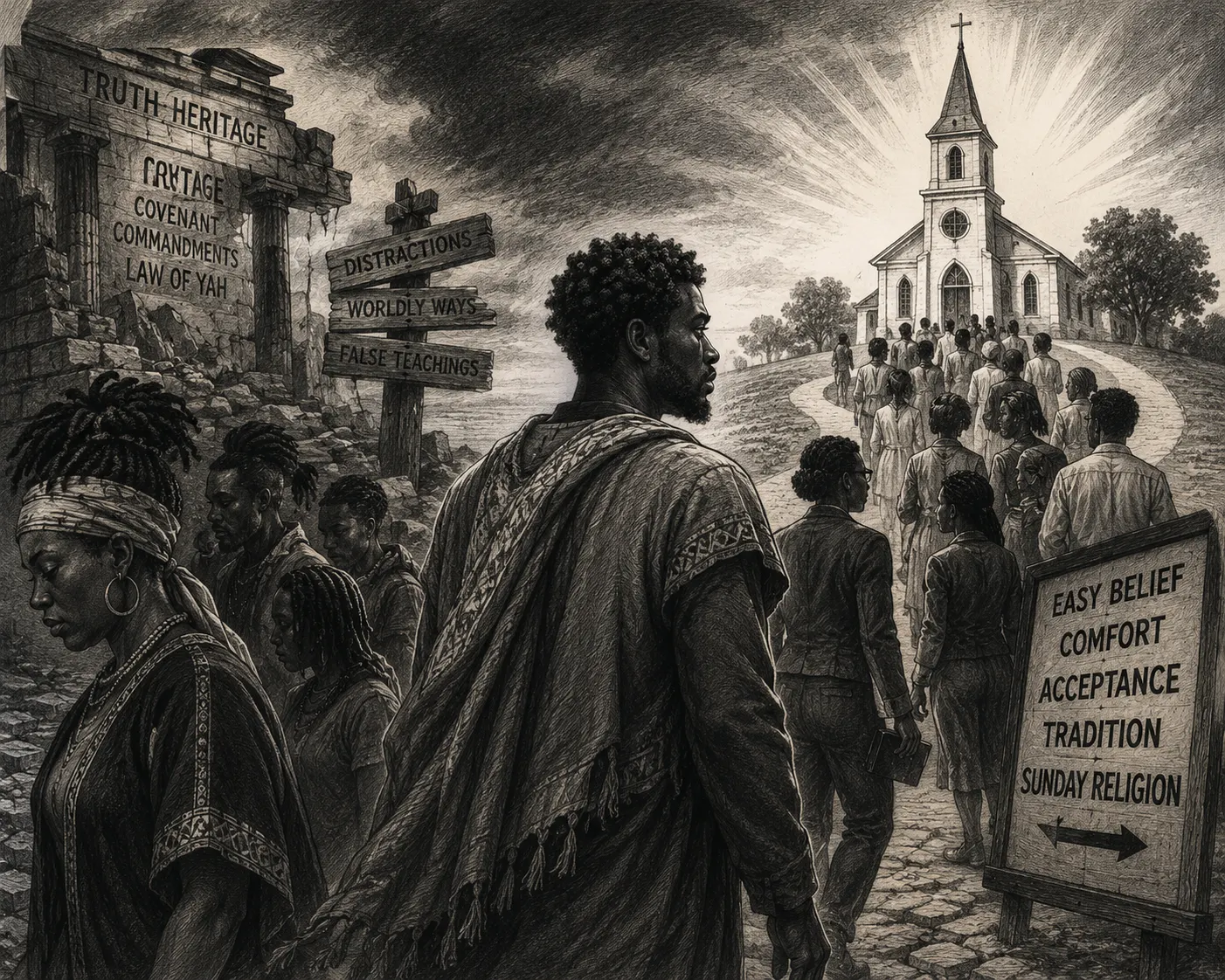

Why These Scriptures Must Be Examined Carefully
One of the main reasons people believe the law has been done away with is not because they have carefully studied the entire Bible from beginning to end, but because they have been taught to rely on a small group of verses—often taken from Paul’s letters—without examining their full context. These verses are frequently presented in isolation, without comparison to the Torah, the prophets, or even other statements by the same apostle.
This creates a dangerous situation where a person can unknowingly believe something that contradicts the very foundation of Scripture. The words of the Messiah, the commandments given through Moses, and the prophecies concerning obedience and judgment all establish a consistent standard. If a handful of verses seem to undo that standard, then the issue is not with the Word—it is with how those verses are being interpreted.
When we approach these scriptures honestly, we find that none of them actually teach the removal of the law. Instead, they address misunderstanding, misuse, or misapplication of the law. The problem is not the verses themselves, but the interpretation placed upon them.
Romans 6:14 — “Not Under the Law, But Under Grace”
Romans 6:14 (KJV)
“For sin shall not have dominion over you: for ye are not under the law, but under grace.”
This verse is often used to argue that the law no longer applies and that grace has replaced the need for obedience. The Christian interpretation suggests that being “not under the law” means the commandments are no longer binding.
However, this interpretation immediately breaks down when the next verse is read.
Romans 6:15 (KJV)
“What then? shall we sin, because we are not under the law, but under grace? YAHUAH forbid.”
Paul clearly rejects the idea that grace allows continued sin. This forces us to define sin properly.
1 John 3:4 (KJV)
“Whosoever committeth sin transgresseth also the law: for sin is the transgression of the law.”
If sin is the breaking of the law, then the law must still exist. Otherwise, sin would have no definition. Our understanding holds that being “not under the law” means being freed from its direct condemnation, not from its instruction. Grace removes punishment for past transgression, but it does not eliminate the standard of righteousness, which is the law.
(See our books, Has the Law been done away with? and The Symbiotic Relationship: Grace & Law for a more in-depth explanation)
Galatians 3:24–25 — “No Longer Under a Schoolmaster”
Galatians 3:24–25 (KJV)
“Wherefore the law was our schoolmaster to bring us unto Christ, that we might be justified by faith.
But after that faith is come, we are no longer under a schoolmaster.”
This passage is often interpreted to mean the law is no longer necessary. But this interpretation misunderstands the role of a schoolmaster. A teacher does not become useless once a lesson is learned. Instead, the student is expected to live according to what they were taught.
The law teaches:
what sin is
what righteousness is
what obedience looks like
It leads a person to the Messiah by revealing their need for repentance. Once they come to that understanding, they do not abandon the law—they now follow it with clarity. The Christian interpretation assumes that learning removes responsibility, but our understanding shows that learning increases responsibility.
(See our book, Baptism Unto Remembrance: Sin-Atonement-Repentance)
Colossians 2:14 — “Blotting Out the Handwriting of Ordinances”
Colossians 2:14 (KJV)
“Blotting out the handwriting of ordinances that was against us… and took it out of the way, nailing it to his cross.”
This is often interpreted to mean the commandments themselves were nailed to the cross. But this creates a contradiction, because Scripture consistently describes the law as holy and good.
Romans 7:12 (KJV)
“Wherefore the law is holy, and the commandment holy, and just, and good.”
If the law is good, it cannot be what is “against us.” What was removed is the record of sin—the debt that resulted from breaking the law. Specifically, under the law, when the Israelites decided to go after other gods, then under the law, that would be defined as adultery, as the Israelites were the bride of YAHUSHUA. So what was against us was the law of adultery, which made us set for death, but YAHUSHUA came and died for those sins of adultery, allowing us to be renewed in a new covenant with Him. We have an understanding that distinguishes between the law itself and the penalty for violating it. The Christian interpretation confuses the two and lacks the basic context of what YAHUSHUA’s death was for.
(See our book, Song of Solomon: A Complete Breakdown)
Ephesians 2:15 — “Abolished in His Flesh”
Ephesians 2:15 (KJV)
“Having abolished in his flesh the enmity, even the law of commandments contained in ordinances…”
This verse is often used to claim the entire law was abolished. However, the context is about the division between groups of people and the removal of hostility. The “enmity” refers to separation, not righteousness.
Our understanding recognizes that this passage is about reconciliation, not the removal of YAH’s commandments. The Christian interpretation fails because it ignores the surrounding context and assumes all law is being addressed. When, in actuality, it was enmity between different groups of Israelites. Specifically, the ones who lived as Israelites their whole lives, and newly converted Israelites coming back to their birthright that they or their families had left.
(See our book, The Chosen Seed: Predestination)
Romans 10:4 — “Christ Is the End of the Law”
Romans 10:4 (KJV)
“For Christ is the end of the law for righteousness to every one that believeth.”
The word “end” is often misunderstood to mean termination. But in biblical usage, it means “goal” or “purpose”. The Messiah is the fulfillment of what the law points toward, which is righteousness. It was the “end” of the Levitical priesthood to make room for the “Original” priesthood that of the Order of Melchizedek.
Psalm 119:172 (KJV)
“…for all thy commandments are righteousness.”
Righteousness is still defined by the commandments. Therefore, the law cannot have ended. Our understanding aligns with this, while the Christian interpretation redefines the term “end” in a way that creates a contradiction in terms.
(See our books, The Path: Of Righteousness and The Order Of Melchizedek: According to the 12 Patriarchs)
Hebrews 7:12 — “Change of the Law”
Hebrews 7:12 (KJV)
“For the priesthood being changed, there is made of necessity a change also of the law.”
This verse is used to claim that the entire law changed. But the context is clearly about the priesthood. The change applies to sacrificial and priestly functions, not moral commandments.
Our understanding maintains this distinction. The Christian interpretation expands the scope beyond what the text actually states. And they do not understand that Paul (Saul) was explaining the Order of Melchizedek, which was an OLDER priesthood than the Levitical (Aaronic) priesthood. In that priesthood which was led by YAHUSHUA HA’ MASHIAC, it made it harder, not easier, to keep the written law. As now even your thoughts will be judged, not just your actions.
(See our book, The Order Of Melchizedek: According to the 12 Patriarchs)
Acts 10 — Peter’s Vision
Acts 10:13–15 (KJV)
“And there came a voice to him, Rise, Peter; kill, and eat.
But Peter said, Not so, YAHUAH; for I have never eaten any thing that is common or unclean.
And the voice spake unto him again… What YAHUAH hath cleansed, that call not thou common.”
This is often used to say dietary laws are gone. But Peter explains the meaning himself.
Acts 10:28 (KJV)
“…YAHUAH hath shewed me that I should not call any man common or unclean.”
The vision is about people, not food. The Christian interpretation ignores Peter’s explanation, while our understanding follows it directly. It was about the Israelites returning to the fold of the “New” or “Renewed” Covenant. It was explained that you shouldn’t call them unclean or common when they were coming back from living as Gentiles. What YAHUAH has “cleansed” is just as important as the Israelites who have been living out Torah their whole lives. They have as much right to the covenant as the Israelites who lived in Jerusalem and kept the Law.
(See our book, The Chosen Seed: Predestination)
Mark 7:18–19 — “Purging All Meats”
Mark 7:18–19 (KJV)
“…whatsoever thing from without entereth into the man… it cannot defile him… purging all meats.”
This passage is about ritual handwashing traditions, not dietary law. The issue being addressed is man-made tradition, not the distinction between clean and unclean animals. Our interpretation respects the context, while the Christian interpretation applies the verse beyond its intended meaning.
(See our book, The Original Bible Diet: What Is the Bible Diet and Why Is Understanding Kashrut So Important to Kosher Eating?)
Romans 7:6 — “Delivered From the Law”
Romans 7:6 (KJV)
“But now we are delivered from the law… that we should serve in newness of spirit…”
Being delivered from the law refers to freedom from condemnation, not from obedience. The law no longer condemns those who repent, but it still defines how they should live. And it is the only way to be a true follower of Christ/ Messiah. What made Him so special? He was a man who lived His whole life without breaking the commandments. So if that is true, then the followers of Him would need to follow the commandments just as He did.
(See our book, Baptism Unto Remembrance: Sin-Atonement-Repentance)
Galatians 5:18 — “Led by the Spirit”
Galatians 5:18 (KJV)
“But if ye be led of the Spirit, ye are not under the law.”
This is often interpreted to mean the Spirit replaces the law. But Scripture explains the role of the Spirit clearly.
Ezekiel 36:27 (KJV)
“And I will put my spirit within you, and cause you to walk in my statutes, and ye shall keep my judgments, and do them.”
The Spirit leads a person into obedience, not away from it. Our understanding maintains this consistency, while the Christian interpretation creates a division that Scripture does not support.
(See our book series, “The Ruach Ha’ Kodesh” for more understanding).
Final Conclusion
When these scriptures are examined honestly, none of them teach that the law has been done away with. Instead, they clarify:
the role of grace
the purpose of faith
the removal of condemnation
the proper understanding of obedience
The Christian interpretation often fails because it removes context and creates contradictions. Our understanding remains consistent throughout the Bible, allowing the Torah, the prophets, the Messiah, and the apostles to agree.
Romans 3:31 (KJV)
“Do we then make void the law through faith? YAHUAH forbid: yea, we establish the law.”
Final Truth
The law has not been done away with.
It has been misunderstood.
And when it is understood correctly, the entire Bible speaks with one voice.
Shalom,
Keep In Touch
Explore the full Unknown Hebrew Collection for more scripture-based studies.
Stay updated with teachings — follow Unknown Hebrew on Substack.
Have questions? Contact Unknown Hebrew directly.